Why Your Frankenstack Is Costing Your Recruitment Agency More Than You Think
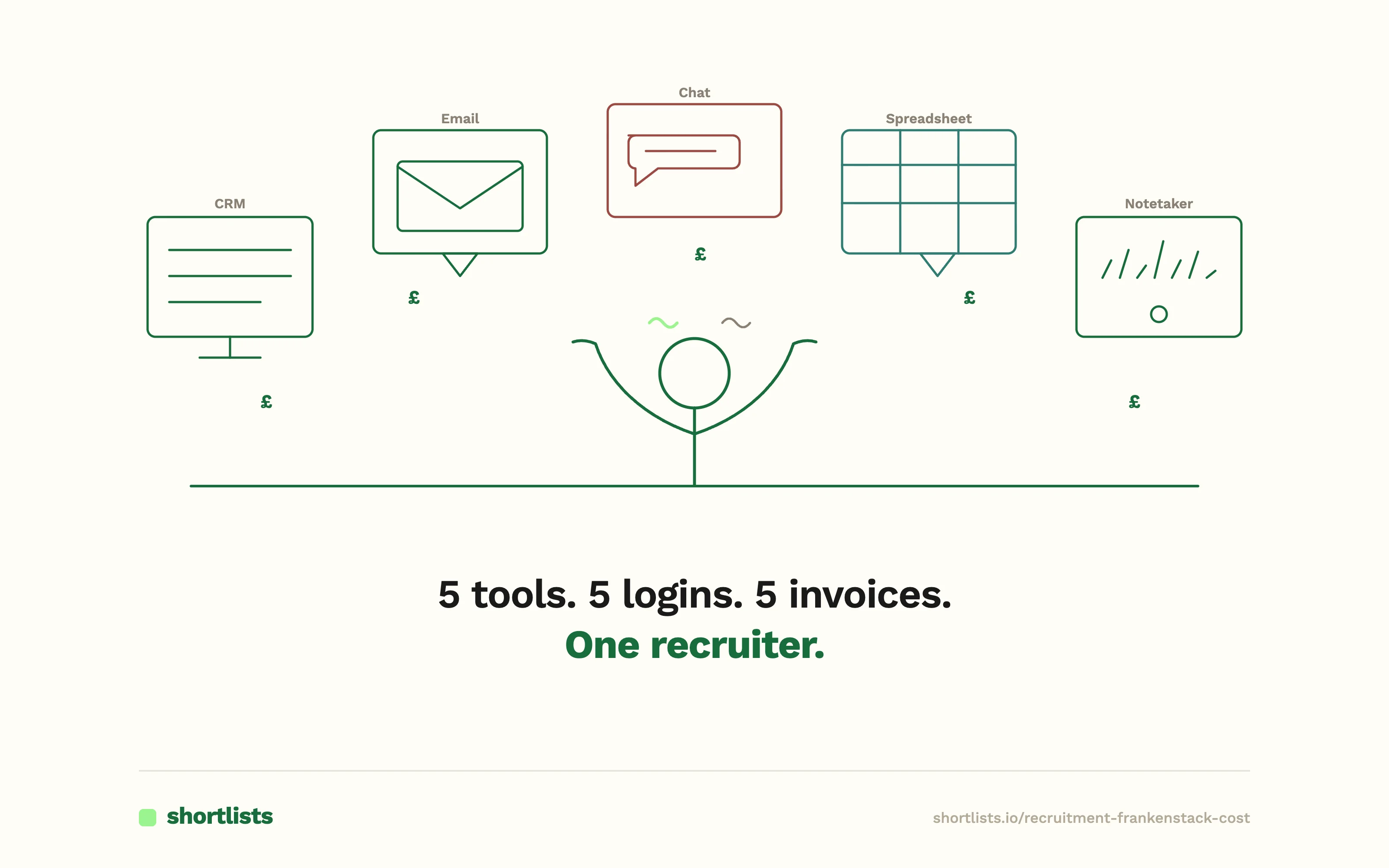
A recruitment frankenstack forms when an agency adds separate tools for CRM, notetaking, enrichment, outreach and automation that do not share one reliable record. For a 3-to-10 seat UK agency, the real cost goes beyond subscriptions, creating duplicate work, inconsistent data, constant context switching and less time for proactive business development.
Key takeaways
- A frankenstack is the collection of separate recruiting tools an agency stitches together, a CRM, a notetaker, an enrichment tool, an outreach tool, an AI assistant, none of which talk to each other.
- The subscription cost is only the visible part. The real cost is the time lost to double entry, the data that falls between tools, and the placements missed because nothing gives you one view.
- A typical small-agency frankenstack runs $324 to $976 a month combined, before anyone has monitored a single business development signal. (Source: Shortlists internal stack analysis.)
- The hidden costs, switching between dashboards, re-keying data, reconciling contradictory records, are larger than the subscriptions and never show up on an invoice.
- Consolidating into one recruiting CRM built for a 3-to-10 seat agency removes both the visible cost and the hidden one.
How a frankenstack forms in a recruiting agency
No agency sets out to build a frankenstack. It accumulates, one reasonable decision at a time.
You start with a CRM. It does the core job of storing candidates and tracking pipeline. Then a gap appears. Writing up call notes is eating your afternoons, so you add an AI notetaker. It is cheap and it works, so the decision is easy.
Then finding candidate contact details becomes the bottleneck, so you add an enrichment tool with its own credit pack. Then you want to run outreach at volume, so you add an outreach tool. Then everyone is talking about AI, so you add an assistant to draft messages and summarise.
Each decision made sense on its own. Each tool solved a real problem. But six months later you are logging into five dashboards, and the candidate you spoke to this morning exists in three of them with slightly different details in each.
That is the frankenstack. Not a mistake, but the natural result of solving problems one tool at a time without anything joining them up.
The cost you can see
Start with the part that shows up on invoices, because even that is higher than most agencies realise until they add it up.
A typical 3-to-10 seat UK agency frankenstack looks something like this: a recruiting CRM, a separate AI notetaker, an enrichment tool with monthly credits, an outreach tool, and some form of AI assistant. Added together, that stack runs $324 to $976 a month combined, depending on the tools chosen and the number of seats. (Source: Shortlists internal stack analysis.)
That range is wide because the tools vary, but the shape is consistent: the CRM is rarely the largest line. The add-ons, taken together, often cost more than the core system they are bolted onto. And that figure does not yet include any business development (BD) signal monitoring, because almost none of these tools do it.
For a five-person desk, the visible frankenstack cost alone can exceed what a single, consolidated recruiting CRM would charge for the same capabilities in one place. But the subscriptions are the smaller half of the story.
The cost you cannot see
The real expense of a frankenstack never appears on a bill. It is paid in time and in lost work, and it is bigger than the subscriptions.
Double and triple entry. A candidate you speak to has to be updated in the CRM, tagged in the outreach tool, and enriched in a third system. The same person, entered by hand more than once. Multiply that across every candidate, every day, across the team, and it is hours a week that produce nothing except keeping five systems roughly in sync.
Data that falls between the tools. When systems do not share data, information gets stranded. The note you made in the notetaker never reaches the CRM. The enriched phone number lives in the enrichment tool but not on the candidate record. The outreach reply sits in a separate inbox. Nobody decided this data should be lost; it just has nowhere to flow to.
Contradictory records. When the same candidate exists in three tools, the three versions drift apart. One has the old email, one has the new title, one has the note about their salary expectation. Now you do not have a single source of truth, you have three partial ones, and you have to reconcile them in your head every time you pick up the phone.
Context switching. Every move between dashboards costs attention. Logging into five tools, remembering which one holds what, rebuilding your train of thought each time you switch, this is a tax on focus that never appears anywhere except in how tired you are at the end of the day and how few calls you actually made.
The integration that never quite works. Some agencies try to wire the stack together with connectors and automation tools. That helps a little and adds its own cost: another subscription, another thing to maintain, another point of failure when one tool updates its interface and the connection quietly breaks.
The biggest cost: the placements you never made
The hidden costs above are about wasted effort. This one is about lost revenue, and it is the most expensive of all.
A frankenstack keeps you reactive. Because no single tool gives you one view of your candidates, your clients and the market, you spend your time maintaining the stack instead of working ahead of it. The admin of keeping five tools in sync is time not spent getting to a hiring manager before a role is posted.
That matters more than it sounds. Of 220 UK agency founders interviewed before Shortlists was built, 217 had no repeatable business development (BD) system, and the three who did earned 2 to 3 times more placement fees than the rest. (Source: Jack Nicoll, 220 UK agency founder interviews, 2025.)
A frankenstack actively works against building that system. The signals that predict a role before it is posted, funding rounds, senior hires, leavers in your niche, are scattered across sources none of your tools monitor. Watching for them manually, on top of maintaining five dashboards, is not realistic on a small desk. So the proactive work that earns the most does not happen, and the agency stays reactive, filling roles that twelve other recruiters already saw.
That is the cost that does not fit on an invoice: not the money spent on tools, but the fees never earned because the tools left no time to work ahead.
How to tell if your recruiting agency has a frankenstack
A few honest questions surface it quickly.
How many tools do you log into in a normal day? If the answer is more than two to run your core recruiting workflow, you are likely running a stack rather than a system.
Does the same candidate exist in more than one tool? If a name lives in your CRM, your outreach tool and your enrichment tool separately, and you update them by hand, that is the frankenstack signature.
When you get a call reply, does it update your CRM automatically? If the answer is no, if replies, notes and enriched details have to be moved by hand, your tools are not connected, they are just co-located.
Add up every recruiting subscription you pay for. Not just the CRM. The notetaker, the enrichment credits, the outreach tool, the assistant, any connector holding it together. The total is usually higher than agencies expect, and it is the visible floor of a larger cost.
If those questions land uncomfortably, the stack has formed. The good news is that it is fixable, and fixing it usually costs less than the stack it replaces.
When a stack is actually fine
An honest point, because not every collection of tools is a problem.
If you run a large firm with an IT function that maintains integrations, a stack of specialised tools wired together can work well. Enterprises make that trade deliberately: more tools, more capability, and a team whose job is keeping them connected. For them, the maintenance cost is absorbed by people hired to absorb it.
A 3-to-10 seat UK agency does not have that team. Every hour spent keeping tools in sync is an hour a recruiter is not billing. That is the difference: the same stack that is manageable for a 200-person firm is a genuine drag on a five-person desk, because the maintenance falls on the people who should be recruiting.
So the question is not "are multiple tools always bad?" It is "who is paying the cost of holding them together, and could that time be spent on placements instead?" For a small agency, the answer usually points toward consolidation.
How Shortlists handles this
Shortlists is a recruiting CRM built for 3-to-10 seat UK agencies, and it is the direct alternative to a frankenstack: one system that does the jobs the separate tools were bought for.
The CRM, ATS, interview notetaker, client portal, outreach with open and click tracking, and 40 enrichment credits per user a month are all in one tool, at one price of $120 per user a month. A candidate you speak to is transcribed by the notetaker, enriched automatically, and updated on a single record, no re-keying, no separate dashboards, no drifting copies.
Because everything sits in one place, the proactive work becomes possible. BD Radar scans funding rounds, senior hires and leaver signals overnight and gives you a ranked list of companies worth calling before the role is posted, the exact work a frankenstack leaves no time for.
One bill instead of five. One login instead of five. One record per candidate instead of three that disagree. At $120 per user a month against a stack that runs $324 to $976, the consolidation removes both the visible cost and the larger hidden one, and for many agencies it is the cheaper option before the time savings are even counted.
Moving across is free, handled by the Shortlists team rather than an external partner, with most agencies live within 48 hours. Shortlists is used by 55+ UK recruitment agencies, billed month to month with no annual contract.
FAQ
What is a frankenstack in recruitment?
A frankenstack is the set of separate, disconnected tools a recruitment agency stitches together to run its workflow, typically a CRM plus a notetaker, an enrichment tool, an outreach tool and an AI assistant. The name captures the problem: the parts were assembled one at a time and do not work as a single system, so data does not flow between them and the same candidate ends up in several tools at once.
How much does a recruitment frankenstack cost?
The subscriptions for a typical small-agency stack run $324 to $976 a month combined, depending on the tools and seats. (Source: Shortlists internal stack analysis.) That is only the visible cost. The larger expense is the time lost to double entry, data stranded between tools and the placements missed because no single tool gives you one view of the market.
Why is a frankenstack a problem for a small agency specifically?
Because a small agency has no IT team to maintain the connections between tools. Every hour a recruiter spends re-keying data or reconciling contradictory records is an hour not spent billing. A large firm can absorb that maintenance with dedicated staff; a 3-to-10 seat agency pays for it directly in lost recruiting time.
How do I know if my agency has a frankenstack?
Ask how many tools you log into daily to run your core workflow, whether the same candidate exists in more than one of them, and whether a call reply updates your CRM automatically or by hand. If you run more than two tools, maintain duplicate records, and move data manually, you have a frankenstack. Adding up every recruiting subscription usually confirms it.
Is it always better to have one tool than several?
Not always. A large firm with an IT function can run a stack of specialised tools and maintain the integrations deliberately. The calculation changes for a 3-to-10 seat agency, where the maintenance falls on the recruiters themselves. For a small agency, consolidating into one recruiting CRM usually costs less and frees up the time the stack was quietly consuming.
How do I move off a frankenstack without losing data?
Consolidate into a single recruiting CRM and migrate your records across. The key is that migration is handled for you and does not lose your notes and history. With Shortlists, migration is free, run by the Shortlists team, with most agencies live within 48 hours. Your data then lives on one record instead of scattered across several tools.
Next steps
If you log into more tools than you can comfortably count, and the same candidate lives in several of them, the frankenstack has formed. Consolidating usually costs less than the stack it replaces, and gives back the time the stack was taking. Shortlists is built for 3-to-10 seat UK agencies, and used by 55+ of them.
- Book a Demo and we will map your current stack against one Shortlists subscription. If you are mid-contract on any of those tools, you can use Shortlists at $40 per user a month until your existing contract ends, so consolidating does not mean paying twice.
- Find out More about how Shortlists replaces the stack.
- See BD Radar, the candidate database, and the full comparison against the tools a frankenstack is built from.