What Is Pre-Job Posting Intelligence in Recruitment?
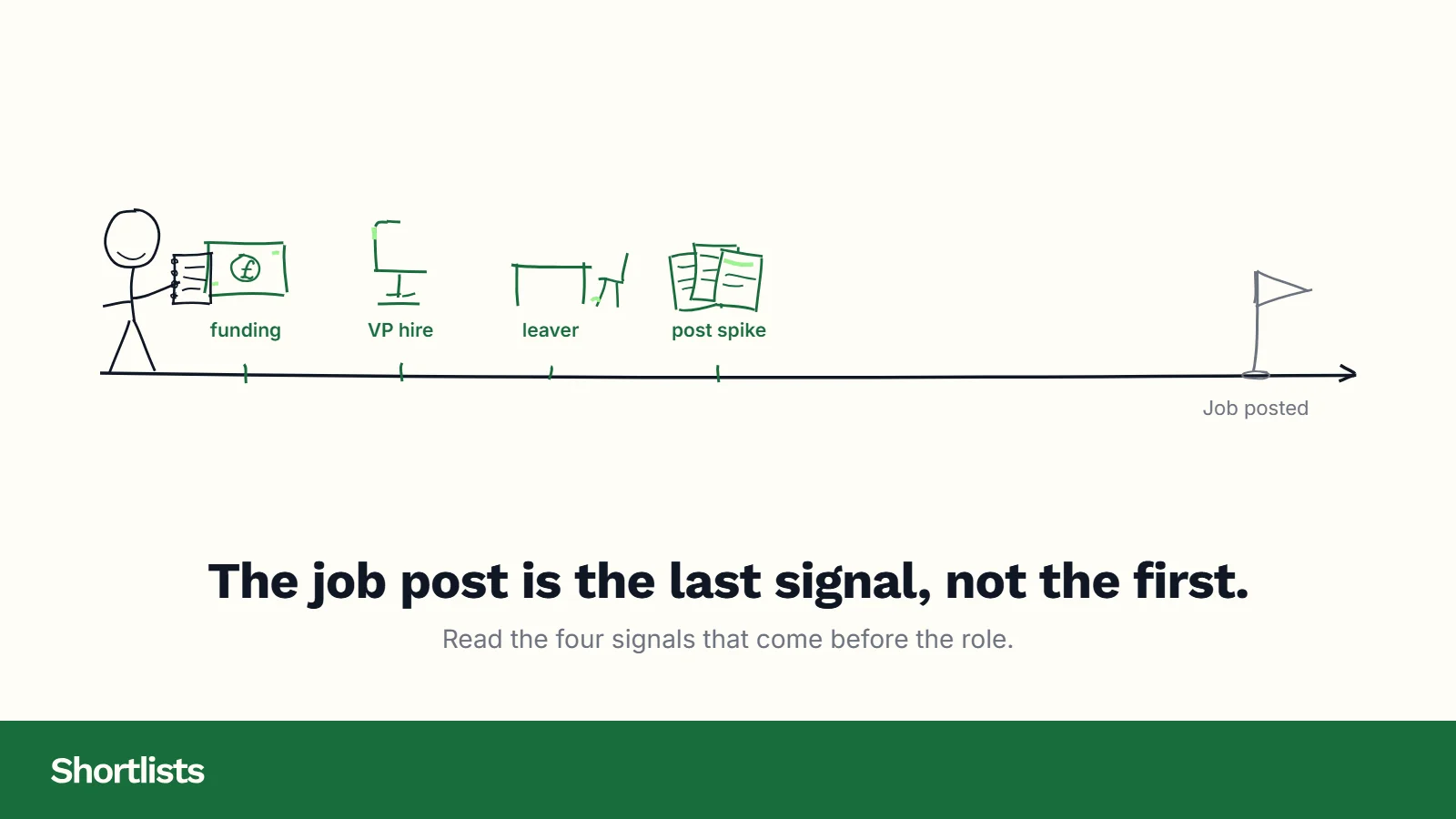
By the time a role lands on LinkedIn Jobs, you are already late. The listing goes live, and within hours ten agencies are on it, all sending the same candidates to the same hiring manager, all competing on speed and price. You can win that race occasionally. You cannot win it consistently, and you certainly cannot win it on margin.
There is an earlier game, and a handful of agencies have always played it. They reach the hiring manager before the job exists. Not by hustling harder, but by reading the signals that come before almost every hire.
Pre-job posting intelligence is the practice of reading those signals, the events that reliably precede a vacancy, so you start the conversation while the role is still a thought in someone's head rather than a post on a job board. This piece does three things: it explains why the job post is already too late, it names the four signals that predict a role before it exists, and it shows how a small agency runs this without a research team.
This is not a product demo, and it is not a cold-outreach listicle. It defines a category and a method. The tools come later.
Why the job post is already too late
A job post is a finish line dressed up as a starting gun. By the time it appears, a sequence has already happened inside the hiring company. A need emerged. A budget got approved. A manager wrote a spec. Sign-off worked its way through. Only then does the role go public.
Every step in that sequence was a moment you could have been in the conversation. The post is the last of them, not the first.
When you arrive at the post, two things are already lost. The first is exclusivity. The role is now visible to everyone, which means you are one of many, and the hiring manager knows it. The second is margin. A contingent fee negotiated when ten agencies are circling looks very different from a fee agreed when you were the one person who called before the role was even advertised. Speed and price both erode the moment a vacancy goes public.
The agencies that consistently earn more are not necessarily better at sourcing. They are earlier. From Jack Nicoll's body of work building Shortlists, drawn from 220 founder conversations, 217 of those 220 agencies had no systematic way of getting there first. Three did. Those three earned two to three times more in fees. The difference was not effort. It was timing.
What pre-job posting intelligence actually is
Pre-job posting intelligence is reading intent signals that precede a hire, rather than reacting to listings after the fact.
A listing is a record of a decision already made. An intent signal is evidence that a decision is forming. When a company raises a funding round, hires a new VP, loses a senior person, or starts posting a cluster of adjacent roles, it is broadcasting that more hiring is coming, often weeks before any of it reaches a job board. Reading those broadcasts, and acting on them, is the whole discipline.
The shift is from reactive to proactive. Reactive recruiting waits for the role to appear, then competes to fill it. Proactive recruiting watches the conditions that create roles, then reaches the hiring manager while the need is still forming. Same desk, same relationships, earlier entry point.
It is worth saying what this is not. It is not job scraping. Scraping collects listings that already exist, which is still reacting, just faster. Pre-job posting intelligence reads intent before the listing exists at all. One watches the finish line. The other watches the race develop.
The four signals that predict a role before it exists
Almost every hire is preceded by at least one of four signals. Each one is publicly observable. None requires inside information. Define them here, then read the four signals, in detail for the full mechanics of how to monitor and act on each.
Funding rounds
A company that raises capital hires against it, usually fast and usually across several functions at once. A Series A or B round is a near-guarantee of headcount growth in the following quarter. The round is announced publicly. The hiring that follows is not yet on any board. The window between the announcement and the first job post is your entry point.
VP-level and senior hires
When a company brings in a new VP or department head, that person reshapes their team. New leaders hire people they trust, build out functions they care about, and replace what they inherited. A senior appointment is a leading indicator of a wave of hires beneath it. The new VP's arrival is on LinkedIn. The roles they are about to open are not.
Senior leavers (the backfill)
When a senior person leaves, the seat rarely stays empty. The backfill is one of the most predictable hires there is, and it often comes with a ripple, because a senior departure can prompt others to move and create further gaps. A visible senior exit is a signal that a replacement search is coming, frequently before the company has even started it formally.
Adjacent-role posting spikes
When a company suddenly posts several roles in one function, it usually signals a broader build-out, and the roles you do not yet see are part of the same plan. A spike of engineering posts often means the leadership and specialist roles around that team are next. The spike is the visible edge of a hiring wave whose later roles have not been written yet. You read the edge and position for the rest.
Taken together, these four are not a hunch. They are a repeatable framework. Funding rounds, VP hires, senior leavers, and adjacent-role posting spikes are the locked set, and they are observable by anyone willing to watch.
How a small agency runs this without a research team
The obvious objection is time. A 3-to-10 seat agency does not have an analyst poring over Crunchbase and LinkedIn all day. It does not need one. The method works as a lightweight weekly routine, not a full-time job.
The shape of it is simple. Once a week, ideally a Monday, you check the four signals across the companies and sectors you specialise in. Who raised. Who hired a senior leader. Who lost one. Where the posting spikes are. That scan produces a short list of companies showing intent.
From that list, you build a shortlist of the people you would put in front of each, drawing on the candidates you already know. Then you send one good message to the hiring manager, referencing the signal, not the role, because the role does not exist yet. "I saw you closed your Series B, congratulations. You will be building out your engineering team. I work with senior backend people in payments and have two I would put in front of you now."
Signal, then shortlist, then warm outreach. That is the routine. Done weekly, it gets you into conversations before the job is posted, which is the entire point. This is the system built for the 217, the founders who have been winging BD without one.
Frequently asked questions
What is pre-job posting intelligence?
Pre-job posting intelligence is the practice of reading the signals that precede a hire, such as funding rounds, senior hires, senior departures, and adjacent-role posting spikes, so you reach the hiring manager before the role is advertised. It replaces reacting to job listings with reading the intent that creates them, which lets a small agency enter the conversation earlier and on better terms.
How do recruiters find jobs before they are posted?
They watch publicly observable intent signals rather than job boards. A funding round, a new VP, a senior departure, or a cluster of related job posts each indicate that more hiring is coming, usually weeks before any role goes live. Recruiters monitor these signals across their niche, then reach out to the hiring manager while the need is still forming.
What are hiring signals in recruitment?
Hiring signals are observable events that reliably precede a hire. The four core signals are funding rounds, VP-level or senior hires, senior leavers who need backfilling, and spikes in adjacent-role postings. Each indicates that a company is about to grow its headcount, often before any specific vacancy has been written down or published.
Can a small recruitment agency do pre-job posting intelligence without a big team?
Yes. The method runs as a lightweight weekly routine rather than a full-time research function. A founder or consultant checks the four signals across their niche once a week, builds a shortlist from candidates they already know, and sends a small number of warm, signal-led messages. It is designed to fit a 3-to-10 seat desk, not to require a research department.
Is pre-job posting intelligence the same as job scraping?
No. Job scraping collects listings that already exist, which is still reacting to roles after they are public. Pre-job posting intelligence reads intent signals before any listing exists. One automates the reactive game and competes faster on roles everyone can see. The other gets you to the hiring manager before the role becomes visible at all.
How Shortlists handles this
Shortlists builds this discipline into the product through BD Radar, which monitors funding rounds, VP hires, senior leavers, and adjacent-role posting spikes across your niche and surfaces them as they happen. It knows who's hiring before anyone else does, so the weekly scan that would otherwise eat an afternoon becomes a short list waiting for you. For the full method, see find hiring signals before jobs are posted.
Next steps
To understand why the BD block feels so heavy in the first place, read the 2-3 hours a day recruiters lose to BD. For the mechanics of each signal, read the four signals, in detail. And to see how AI clears the admin so the hour goes to conversations, read how AI wins back admin time. Or explore BD Radar and the full guide to finding hiring signals before jobs are posted.
Get to the hiring manager before the job is posted.