Why Most Recruiters Spend 2-3 Hours a Day on BD (And How AI Changes This)
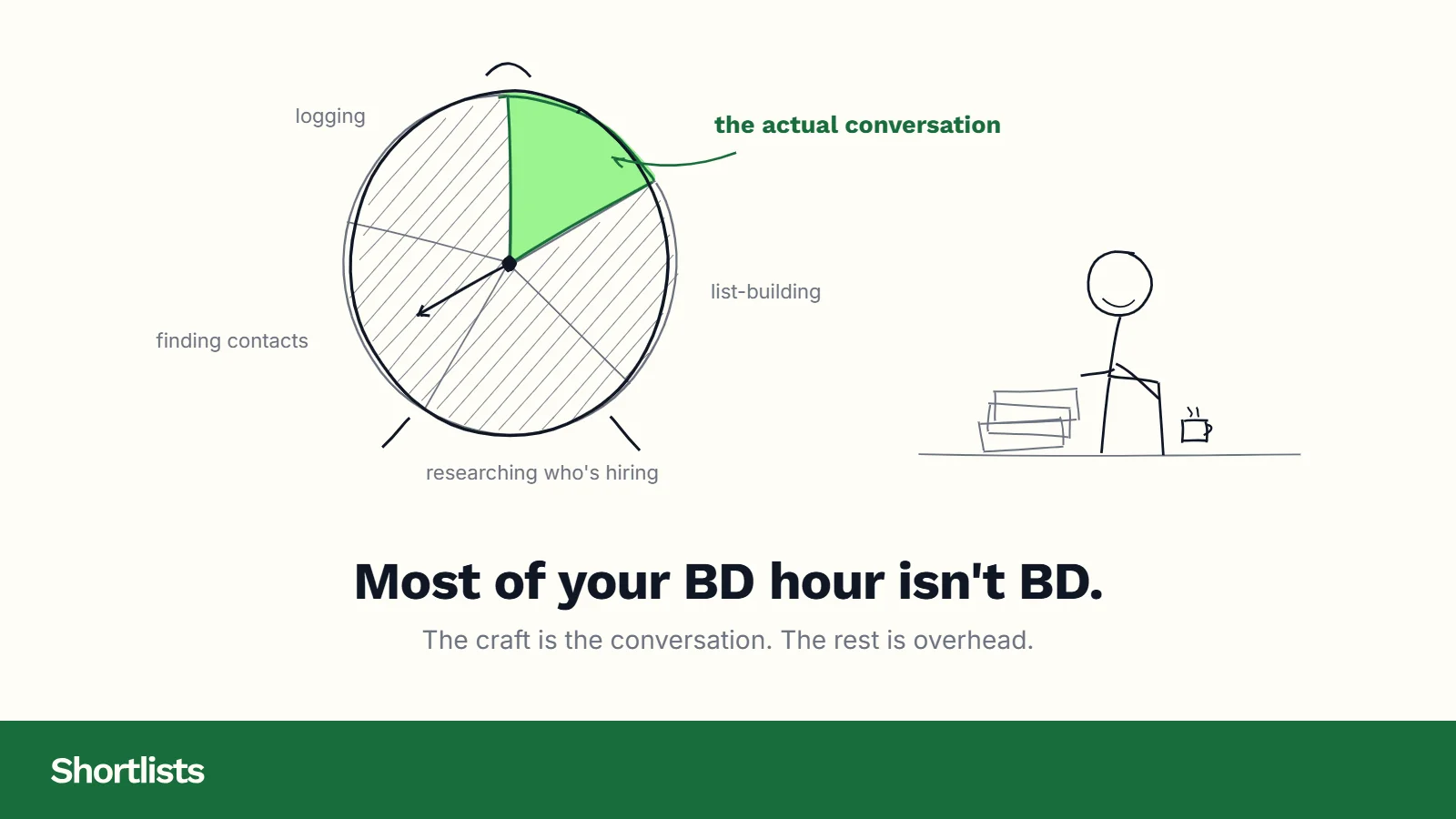
Ask a small-agency founder how much of the day goes to business development and you will hear some version of "a couple of hours, if I am disciplined." Then watch where those hours actually land. Building a list of companies to approach. Working out which of them is hiring. Hunting down a contact's email. Logging what you did so you remember next week. Somewhere in there, briefly, an actual conversation.
That is the catch. Most of the BD block is not BD. It is the admin around BD, the setup and the clean-up, wearing a BD costume. The part that earns fees, the conversation and the judgment behind it, is the smallest slice of the hour.
Recruiters commonly report spending a couple of hours a day on business development, but most of that time is admin that surrounds the work rather than the conversation itself. [Verify: attach a named REC or Recruiter UK benchmark for the "2-3 hours" figure, or reframe to a sourced range, before publish. Do not let the title assert an unsourced stat.] This piece breaks down where the hours actually go, separates the craft from the overhead, and is honest about what AI can take off your desk and what it cannot.
To be clear about the register: this is not "automate your BD and stop talking to people." The recruiter still owns the relationship. AI clears the runway to it.
Where the 2-3 hours actually goes
Open up a typical BD block and it comes apart into four chunks, plus the one that matters.
First, list-building. Deciding which companies to approach this week, pulling them together, deduping against who you already spoke to. It is necessary and it is slow, and none of it is a conversation.
Second, researching who is hiring. Checking which of those companies actually has a need right now, scanning for funding news, new leaders, departures, job-board activity. This is genuinely valuable work, which is exactly why it eats time. You are doing analysis by hand.
Third, finding contact details. The right hiring manager's name, their email, their direct line. The unglamorous scavenger hunt that stands between you and the message you want to send.
Fourth, logging. Recording what you did, when, and what comes next, so the effort is not lost by Friday. Most CRMs make this a chore, which is why so much of it never gets done and the pipeline leaks.
And fifth, the conversation. The call, the message that earns a reply, the read on whether this manager is worth pursuing. This is the BD. This is the craft. And in most BD blocks, it is the thinnest wedge of the lot.
The other four are real work. But they are not the work that only you can do.
The hidden tax: admin disguised as business development
Here is the reframe that changes how the block feels. The craft of BD is the conversation, the relationship, and the judgment that decides who is worth your time. Everything before and after that, the list, the research, the contact-hunting, the logging, is overhead. It is the tax you pay to get to the part that matters.
The tools the industry has given small agencies never removed that tax. They mostly added to it. A CRM that needs careful feeding becomes another thing to maintain, another place the admin lives. The recruiter ends up serving the system instead of the system serving the recruiter. "I spend more time in the CRM than on calls" is one of the most common things founders say, and it is an indictment of the tooling, not the recruiter.
Recruiting is one of the most important jobs in the economy. Matching the right person to the right work changes careers and builds companies. The tools have rarely acted like it. They have treated the craft as an afterthought and the admin as the product. The respectful position is the reverse: protect the conversation, and clear everything around it.
That reframe matters because it points the solution somewhere precise. The problem is not that BD takes too long. It is that the wrong part of BD takes too long. Fix the overhead, and the hour becomes mostly craft.
What AI can take off the desk (and what it can't)
This is the spine of the piece, so it is worth being exact. The honest division is not "AI does BD." It is "AI does the admin around BD, and the recruiter does the BD."
What AI does well
AI is good at the four chunks that are not the conversation.
It finds the signals, watching for funding rounds, senior hires, departures, and posting spikes across your niche so you are not scanning by hand. It builds the lists, assembling and deduping the companies worth approaching. It enriches the contacts, surfacing the right hiring manager and their details so the scavenger hunt disappears. And it logs the activity, capturing what happened without you stopping to type it up, so the pipeline stays current on its own.
None of that is glamorous. All of it is the overhead currently eating your block. Hand it over and the tax shrinks.
What stays with the recruiter
AI does not make the call, and it should not pretend to. The judgment of who is genuinely worth pursuing stays with you. The relationship, the trust built over months that makes a manager pick up your call, stays with you. And the message that earns a reply, the one that reads the moment and sounds like a person rather than a template, stays with you, because the second BD outreach feels automated, it stops working.
That is the line, and it is a firm one. AI takes the admin. The craft stays with you. Any tool promising to run your BD while you sleep is selling the part of the job you should never give away.
A lighter BD block: 30 minutes that compounds
Take the tax out and the block reshapes completely. Instead of two hours mostly spent on setup, you get something closer to thirty focused minutes, most of which is the part that pays.
The shape is simple. The signals are already surfaced when you sit down, so there is no scanning. You read the short list, decide which companies are worth a move this week, and pull together a shortlist from candidates you already know. Then you spend the bulk of your time on the only thing that earns: one good message, or one good call, per opportunity. Signal, then shortlist, then one message that sounds like you.
Done consistently, that block compounds. A small number of warm, signal-led conversations every week beats a sporadic two-hour blitz every fortnight, because relationships are built on regularity, not intensity. The thirty minutes is not a shortcut. It is the same craft with the overhead removed, repeated often enough to build something. For the full routine, read the 30-minute BD routine that compounds.
Frequently asked questions
How much time do recruiters spend on business development?
Small-agency recruiters commonly report spending a couple of hours a day on business development when they are being disciplined about it. The important detail is that most of that time goes to admin around BD, such as list-building, researching who is hiring, finding contacts, and logging, rather than to the conversations and relationship-building that actually win clients. [Verify figure against a named source before publish.]
What counts as business development for a recruiter?
Strictly, BD is the work of winning new clients: the conversations, the relationship-building, and the judgment about which prospects are worth pursuing. In practice the term gets stretched to cover everything around it, including list-building, market research, contact-finding, and CRM logging. Separating the two matters, because only the first is the craft. The rest is overhead that can be cleared.
Can AI do business development for recruiters?
AI can do the admin around BD, not the BD itself. It finds hiring signals, builds and dedupes prospect lists, enriches contact details, and logs activity automatically. It cannot judge who is genuinely worth pursuing, build the trust that makes a manager take your call, or write the message that reads the moment and earns a reply. The relationship stays with the recruiter.
How can a small agency do BD more consistently without more hours?
Remove the overhead, not the conversation. When signals are surfaced for you, lists are built automatically, and logging happens in the background, the BD block shrinks to a short, focused routine: read the signals, build a shortlist, send one good message. A small amount done every week compounds faster than an occasional long session, because consistency, not volume, builds relationships.
Does automating BD make outreach feel impersonal?
It does if you automate the wrong part. Automating the message itself makes outreach feel like spam and stops it working. Automating the admin around the message, the research, the lists, the logging, does the opposite: it gives you back the time to write something genuinely personal. The craft is the message. That stays human. The setup is what should be cleared.
How Shortlists handles this
Shortlists is built around exactly this split. BD Radar surfaces the hiring signals, builds the list, and keeps the pipeline logged, so BD Radar clears the overhead and the hour you spend goes to conversations rather than setup. The AI is included at the base price of $120/user/month, with no annual contract, because the point is to give time back, not to add another tool to maintain. For the repeatable method behind it, see a repeatable way to find hiring signals.
Next steps
To understand the category this sits inside, read what pre-job posting intelligence means. For the full weekly system, read the 30-minute BD routine that compounds. And to see where else AI clears time, read about the admin hours AI wins back. Or explore BD Radar and the full guide to finding hiring signals.
AI takes the admin. The craft stays with you.