AI Recruitment Software for Small UK Agencies: The Complete Guide (2026)
AI recruitment software uses machine learning to automate specific recruiting tasks — candidate matching, interview transcription, outreach drafting, and BD signal monitoring. For a small UK agency, the question isn't whether a platform has AI; it's whether AI is built into the core product or sold as a £20-40/user/month add-on.
Every recruiting CRM now says it has AI. Most of them are telling the truth — and that's the problem.
"AI-powered" tells you nothing useful about whether a feature works for a 5-person agency or a 500-person enterprise. It doesn't tell you what the AI actually does, whether it costs extra, or whether it has access to all of your data or only the slice that was convenient to patch it into. The phrase has become a checkbox. Vendors know buyers are looking for it, so they put it on the homepage, and the conversation ends there.
Small UK agencies are paying for this confusion. Some are being sold AI features at add-on prices that push total software costs to £90-150/user/month. Others are running three separate tools — CRM, notetaker, AI drafting assistant — that don't talk to each other, so the AI in each one only sees a partial picture of what the recruiter actually knows about a candidate or a client.
There is a more useful question than "does this platform have AI?" The useful question is: is the AI built into the core architecture, or was it bolted on after the fact? That distinction shapes everything — what the AI can do, what it costs, and whether it's actually useful in a 5-to-10 seat shop where every hour of admin is an hour not billing.
This piece covers what AI recruitment software actually is, the native-vs-bolt-on architectural fork, what AI does well and poorly in recruiting right now, how to interrogate any vendor's AI claims, and what UK agencies should expect to pay. The short version: the best AI recruitment software for a small UK agency is the kind where AI is baked in, not bolted on.
What AI recruitment software actually is
The 4 jobs AI currently does in recruiting software
The AI capabilities in recruiting platforms in 2026 fall into four categories. They are genuinely useful. They are also finite. Understanding what they are makes it easier to evaluate whether a vendor's AI claims are real.
Candidate matching and ranking. Given a new role brief, the platform surfaces candidates from your database who match — not just by job title keyword, but by skill adjacency, sector experience, and seniority markers pulled from the candidate's full profile. At its best, this replaces the manual database search that used to take 45 minutes. It is only as good as the data underneath it: if your candidate records are sparse or inconsistently tagged, the matches will be sparse and inconsistent.
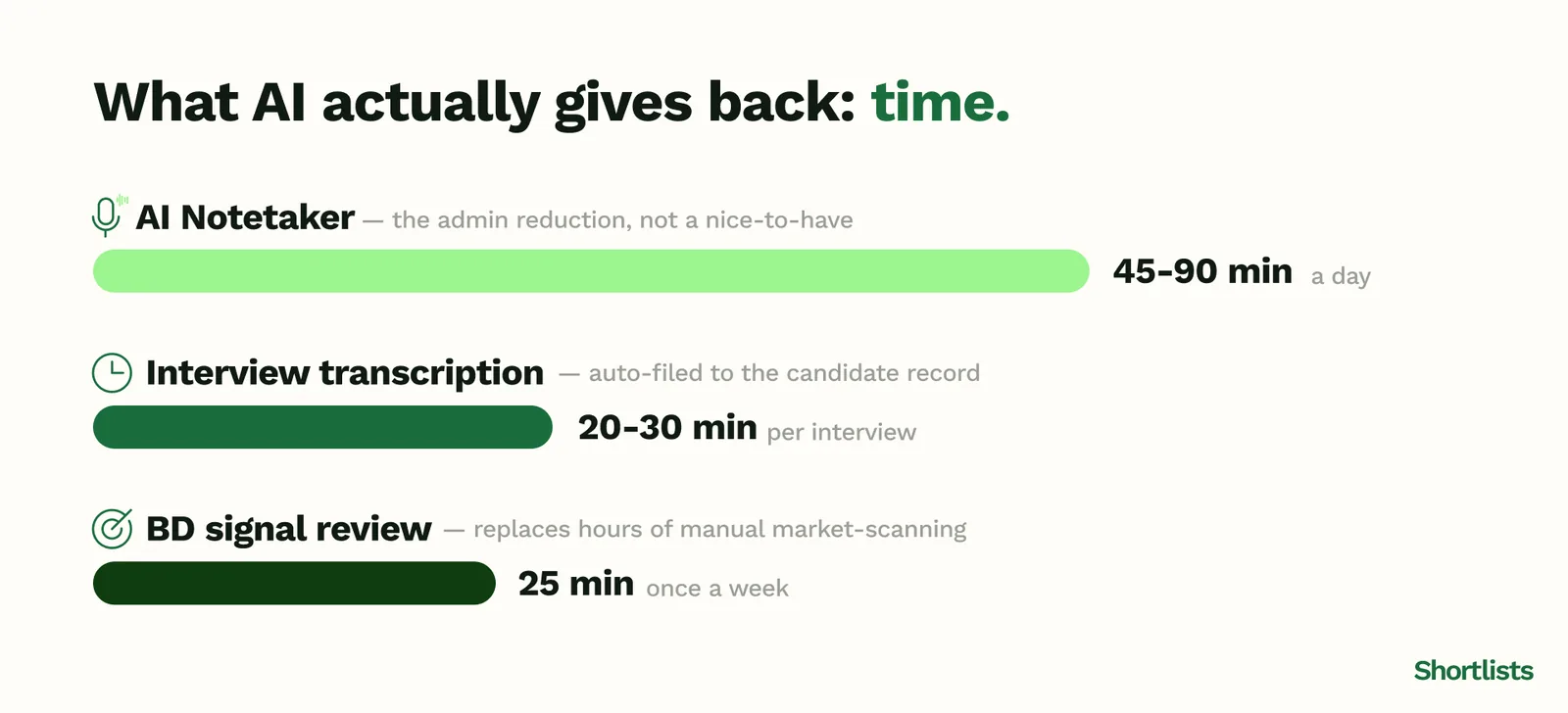
Interview transcription and note-taking. The AI notetaker joins a call, records it, transcribes it, and pulls out structured notes — candidate skills, availability, salary expectation, red flags. The output goes directly into the candidate record in the CRM, bypassing the post-call admin entry that typically takes 20-30 minutes per interview. This is probably the most immediately measurable AI feature in recruiting software, because the time saving is concrete and daily.
Outreach drafting. The AI writes a first draft of a BD email, a candidate outreach message, or a follow-up sequence. It doesn't send anything — the recruiter reviews and edits before anything goes out. This is worth stating plainly because some vendors blur the line between "drafts" and "sends" in their marketing, and automating sends without recruiter review is a different product category with different risk implications.
Signal monitoring and BD intelligence. The platform monitors company signals — funding rounds, senior hires, leadership departures, adjacent-role posting volume — and surfaces them to the recruiter as potential BD triggers. A VP of Sales joining a Series B company you placed at 18 months ago is a signal. A competitor-to-client senior leaver is a signal. The AI aggregates these and serves them up rather than requiring the recruiter to manually monitor LinkedIn and Crunchbase.
These four capabilities are the real ones. Anything described more vaguely than this — "AI-driven insights," "intelligent automation," "smart recommendations" — warrants a follow-up question about which of these four it actually refers to.
What AI doesn't do (yet) in recruiting
The AI handles a specific layer: pattern recognition across structured data, transcription, and first-draft generation. It doesn't handle the rest.
Relationship judgment — knowing whether a candidate who looks right on paper is actually going to thrive in a particular leadership culture — is still a recruiter's read. Hiring manager interpretation — understanding that when a CFO says "strong communicator" they mean something specific to that company's current board dynamic — is still earned through conversations. Niche market knowledge — the kind that comes from spending five years in a specific vertical and knowing the real talent map — isn't something an AI trained on generic recruiting data has access to.
Trust-building with candidates is also still entirely human. Candidates decide whether to take a call, whether to be honest about their real motivations, whether to let an agency represent them, based on their relationship with a specific recruiter. That's not a data problem. It won't become one.
The honest framing is that AI handles the admin layer so recruiters can spend more time on the things only a recruiter can do. That's a meaningful productivity gain. It's not a replacement.
The fork that matters: AI-native vs. AI bolt-on
What AI-native means architecturally
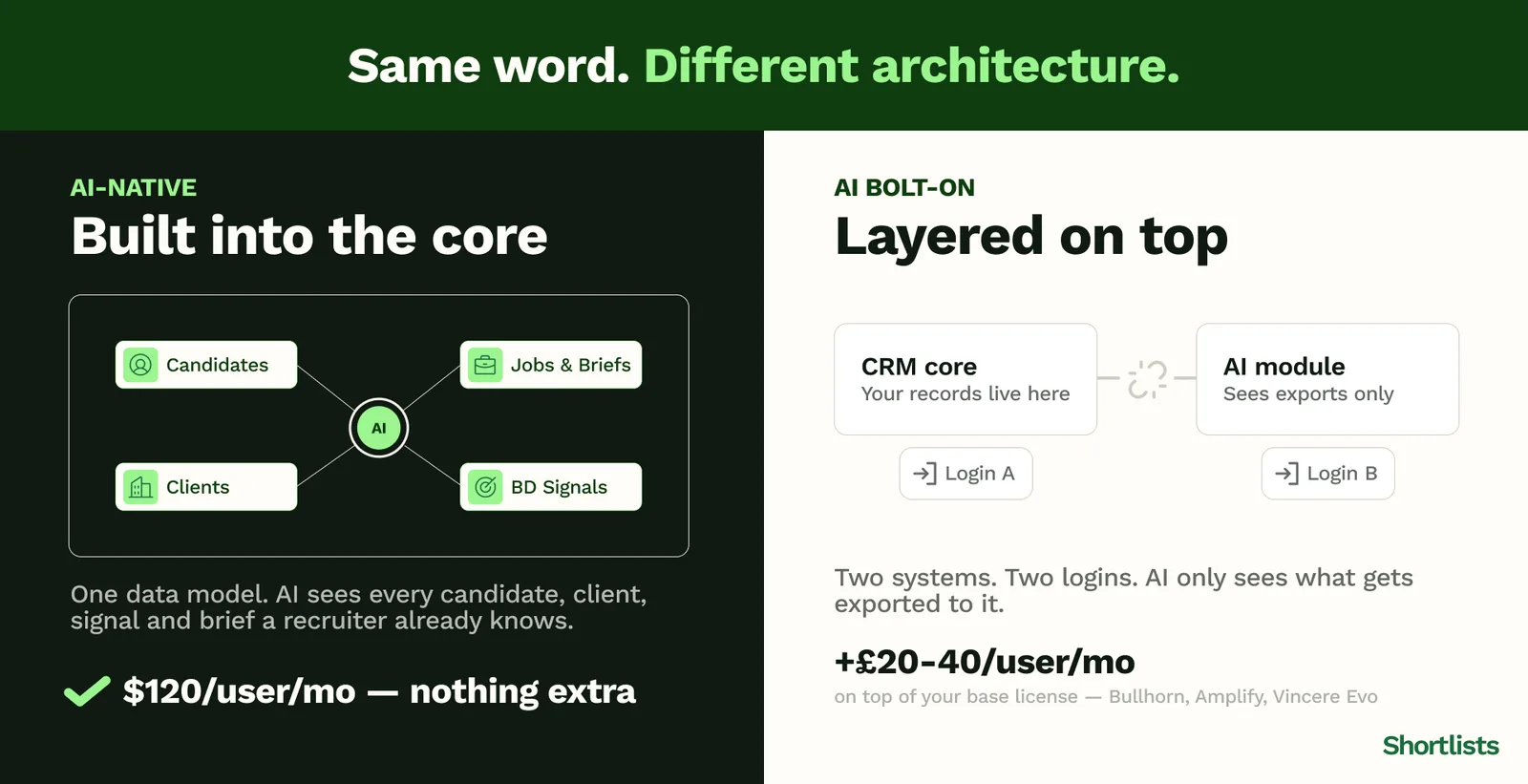
An AI-native recruiting platform is built with AI in the data model from the beginning. The candidate profile, the BD signal layer, the communication history, and the job brief all live in a single unified data architecture. When the AI runs a candidate match, it has access to everything the recruiter knows about a candidate — not just the fields that were in scope when the AI module was added.
This matters because recruiting decisions are made from context, not from individual fields. A candidate who is technically right for a role but who indicated 8 months ago that they're only open to remote work is a poor match for an office-first brief. An AI that only has access to the candidate's most recent job title and skills won't surface that context. An AI that's embedded in the same data layer as the full communication history will.
AI-native also means the AI capabilities don't require a separate login, a separate subscription, or a data export to function. The workflow is unified. The recruiter is in one place.
What AI bolt-on looks like in practice
Bullhorn Amplify is Bullhorn's AI layer. It is an add-on to an existing Bullhorn licence — typically an additional £20-40 per user per month on top of the base licence cost. The AI operates on top of a data architecture that was built before AI was part of the product vision. The result is that Amplify can access some of the Bullhorn data, but the integration is a layer, not a foundation.
Vincere Evo is Vincere's AI module. It operates with a separate interface from the core Vincere product. Recruiters who want to use Evo features are navigating between the main CRM and a separate AI context — which means the AI's recommendations are based on what's been surfaced to Evo, not on the full operational picture in the core platform.
Both are honest attempts to add AI capability to platforms that were built without it. But the architectural constraint is real: AI that's patched into an existing system can only ever see the data it was patched in to access. It can be a useful addition. It cannot be the same as AI that was there from the beginning.
Why this matters for a 5-person agency specifically
The economic comparison is straightforward. On an AI-native platform like Shortlists, the AI is included: a 5-seat agency pays $120/user/month — $600/month all in. On a legacy platform, the AI is a separate line item — a base licence plus an AI add-on that typically runs another £20-40 per user per month on top. Before you've added a single other tool, that AI premium is money leaving the business every month.
At 5 seats, that AI add-on alone is £1,200-2,400 a year. At 8 seats it's £1,920-3,840. These are real numbers for agencies operating on placement margins.
The Frankenstack tax compounds beyond the subscription cost. If the AI notetaker is a third-party tool that doesn't natively integrate with the CRM, someone is copying notes across manually. If the AI drafting assistant doesn't have access to the candidate's communication history in the CRM, the recruiter is pasting context in by hand. Each integration gap creates a manual step. At scale across a team, those steps add up to hours.
The 4 AI features that actually move the needle for small UK agencies
AI notetaker — not a nice-to-have, it's the admin reduction
The AI notetaker is the feature with the clearest and most immediate ROI for a small agency. It joins a call, records it, transcribes it, and auto-fills the candidate profile in the CRM. Skills, availability, salary expectations, stated preferences, red flags from the conversation — all of it lands in the record without the recruiter typing it.
The time saving is in the range of 45-90 minutes per day per recruiter, depending on how many structured interviews or briefing calls they run. At the lower end, that's roughly 4 hours a week — the equivalent of half a billing day returned to the recruiter.
The critical question when evaluating this feature is whether it's native to the CRM or a separate tool. A standalone notetaker like a generic AI transcription service can produce a transcript, but if the recruiter then has to manually transfer that transcript into the CRM, the admin saving is partial. A notetaker that's embedded in the CRM writes directly to the candidate record. That's the version that compounds.
AI candidate matching
When a new role brief comes in, the AI candidate matching feature searches the existing database and returns a ranked list of candidates who fit. The quality differentiator between a good implementation and a poor one is the search interface: whether the recruiter can search in plain English ("senior FD in fintech, Edinburgh-based, not currently active but warm, open to NED") rather than constructing Boolean queries.
The honest caveat on candidate matching is that the quality of the output is directly proportional to the quality of the data going in. If candidate records are sparse, inconsistently maintained, or missing key context, the matching will surface incomplete results. AI candidate matching doesn't fix a data hygiene problem — it amplifies the quality of whatever's already in the database, in either direction.
This is worth naming in any vendor demo: ask to see a candidate match on a role type that represents your core placement volume, using your own data if you're in a trial, and evaluate whether the results are actually relevant.
AI outreach drafting
The AI drafts first versions of BD emails, candidate outreach, and follow-up sequences. The recruiter edits and approves before anything is sent. That order of operations matters and should not be reversed by any platform worth using.
The value is in removing the blank page and the mechanical writing time. A first draft of a BD email that's 70% right is faster to edit than starting from scratch. Across a week of outreach, that compounds into a material time saving.
What the AI cannot do is add the relationship signal that makes the difference between a cold email and a warm one. "I saw you're building the commercial team out following the Series A" is something the recruiter knows because they're paying attention, not something the AI generates from a template. The draft handles the structure. The recruiter adds the intelligence.
Signal monitoring — the BD layer
This is where the AI architecture produces the biggest differentiator for client-side agencies specifically.
The BD signal layer monitors company news, funding announcements, senior hires, executive departures, and adjacent-role posting volume across companies in the agency's target market. It surfaces these as alerts ranked by relevance — so a recruiter who placed a Head of Finance at a company 18 months ago gets a notification when that company posts three commercial finance roles in the same month. That's a conversation worth having.
The practical application is a structured Monday morning routine: 25 minutes reviewing the week's signals, tagging the ones worth acting on, and using the AI outreach drafting to write a first response to each. Done consistently, this is how a 5-person agency builds a proactive BD pipeline without a dedicated business development team.
This is also where the AI-native vs. bolt-on distinction produces the clearest gap. A signal monitoring layer that only has access to a subset of the agency's account data — because the BD intelligence module was added after the fact and doesn't have full access to the CRM's placement and relationship history — produces noisier signals. The recruiter gets more alerts, fewer of which are relevant. An integrated BD layer that knows the full relationship history — who placed where, when, and what the relationship is worth — produces signals the recruiter can act on immediately.
What to actually look for when evaluating AI in a recruiting platform
The 5 questions to ask any vendor
1. Is AI included in the base price or a paid add-on? Get the answer in writing, not just in the demo. Ask specifically whether the AI features you've seen require any additional subscription, tier, or module beyond the base licence. Verify whether the pricing you're being quoted is all-in or whether there are AI line items that appear at renewal.
2. What data does the AI have access to — just candidate records, or BD signals too? Ask the vendor to describe, specifically, what data the AI can query when it performs a candidate match, generates an outreach draft, or surfaces a BD signal. If the answer is vague, ask for a technical diagram or a written description of the data architecture. The answer tells you whether the AI is native or bolted on.
3. Where is the data hosted, and is it UK GDPR compliant? Candidate data in a recruiting CRM is personal data under UK GDPR. The data must be handled in compliance with UK GDPR requirements, which means storage location, processing agreements, and data subject rights all need to be accounted for. Ask whether data is hosted in the UK or EU, whether there are standard contractual clauses in place for any transfers, and where to find the data processing agreement.
4. What does the AI do with my data to train its models? This is the question many vendors would prefer you didn't ask. Some AI implementations train on aggregate user data — which means your candidate records and client communications may be used to improve models that also serve other customers. Ask explicitly: is my data used to train models? If so, how is it anonymised, and can I opt out?
5. What's the product roadmap — is AI on the core team or a third-party integration? Ask where the AI features are built — internally, by the product team, or via a third-party AI provider whose capabilities are wrapped into the platform. Both models can work, but the answer tells you something about how quickly the AI layer will improve, who has accountability when it produces errors, and how dependent the vendor is on a third party's pricing and availability.
Red flags in AI recruiting demos
A demo that describes AI features in abstractions — "intelligent matching," "smart recommendations," "AI-driven insights" — without specifying what the AI actually does or what data it operates on is a yellow flag. It doesn't mean the feature doesn't work; it means the vendor isn't being precise, and you should push for specifics.
AI features that are locked behind a higher pricing tier or are listed as "add-ons" or "modules" in the pricing documentation should prompt a cost-modelling exercise before you proceed. Work out the all-in cost per seat including every feature you intend to use, not just the headline licence fee.
No answer on GDPR and data sovereignty is a hard stop. If the vendor can't or won't confirm where data is hosted, what processing agreements are in place, and whether your data is used in model training, that's not a vendor you should be trusting with candidate personal data.
AI that requires manual export and import between tools is a Frankenstack indicator. If the vendor's answer to "how does the AI notetaker get data into the CRM" involves a CSV export, a copy-paste step, or a Zapier integration maintained by the customer, the admin saving you were promised doesn't exist.
AI and the craft — the honest framing
The current moment in recruiting AI produces two different responses from agency founders. The first is to embrace AI as a way of doing more human work — using the admin saving to spend more time on the calls, the relationships, and the judgment that only a recruiter can provide. The second is to use AI to do less work entirely — to automate more of the process, reduce the human contact points, and improve margin by reducing headcount.
The first approach produces better placements, stronger candidate and client relationships, and a more defensible agency over time. The second approach produces a commoditised service that competes on speed and volume — which is a market that's already crowded and getting more so.
The agencies that are building durable businesses in 2026 are the ones using AI to give their recruiters more time to be recruiters. The notetaker handles the post-call admin. The matching surfaces the candidates worth calling. The BD signal layer identifies the conversations worth having. Then the recruiter makes the call, reads the room, and makes the placement. That division of labour is where AI earns its place in the stack.
Niche expertise, relationship depth, and hiring manager judgment are not going to be automated. The market map that a recruiter builds over five years in a specific vertical — knowing not just who's in the space but who's well-regarded, who's quietly looking, who won't work for whom — is not reproducible from a training dataset. That knowledge, and the trust that comes with it, is the product. AI handles the admin around it.
UK-specific AI concerns in 2026
The EU AI Act and UK equivalents — what applies to recruiting software
The EU AI Act's high-risk AI system provisions became directly applicable in August 2026. AI systems used for recruitment, candidate screening, and employment decisions fall within the Act's high-risk classification. For UK agencies, the Act applies if the vendor's AI is developed or deployed in the EU, or if the agency places candidates into EU-based roles. Even outside the EU's direct jurisdiction, the UK is developing its own AI regulatory framework with similar high-risk classifications anticipated.
What "high-risk" means in practice is that AI systems used in candidate screening must meet specific transparency, accuracy, and human oversight requirements. The AI cannot be the final decision-maker in hiring; it must be clearly identified as AI to candidates it interacts with; and there must be documented human review in the decision loop.
When evaluating any platform, ask the vendor directly: how does your AI comply with the EU AI Act's high-risk requirements? A credible vendor will have a documented answer. A vague answer — "we're monitoring the regulatory landscape" — is not sufficient if you're placing candidates into EU roles or using EU-originated AI.
Deepfake candidates and AI misrepresentation
The growth of AI-generated job applications — CVs, cover letters, interview performance, and video presence that has been artificially enhanced or entirely fabricated — is a real and growing problem in recruiting. The vector matters because it affects the reliability of candidate data that feeds into your AI-native CRM: if the candidate data going in is misrepresented, the AI matching coming out is working with corrupted inputs.
Some recruiting platforms are building detection indicators into the workflow — flagging CV language patterns consistent with AI generation, or noting anomalies in video interview performance. These are early-stage capabilities and should be understood as signals for closer human scrutiny rather than definitive verdicts. The recruiter's role in verification — direct conversation, reference contact, structured assessment — remains the primary safeguard.
For small agencies that operate on relationship-based recruiting, the deepfake problem is somewhat self-limiting: candidates the recruiter already knows or can verify through a warm network are lower risk than cold applications from unknown sources. But for agencies with higher volumes of cold candidates, it's a growing due diligence consideration.
UK GDPR and candidate data in AI training
Under UK GDPR, candidate personal data cannot be used for purposes beyond those the candidate consented to at the point of collection. Using candidate data to train an AI model is a separate processing purpose — which means it either requires explicit consent or a legitimate interest assessment that most candidates, if asked, would not support.
The question every UK agency should ask before signing with any AI-enabled recruiting platform: is candidate data used to train AI models, and if so, on what legal basis? The answer should include a specific legal basis under UK GDPR, not just a reference to the privacy policy.
Good data governance from a vendor looks like: UK or EU-based data hosting, a publicly available data processing agreement, opt-out mechanisms for AI training, regular penetration testing, and clear data retention and deletion policies. These are not unusual asks. Any credible vendor operating in the UK market should be able to confirm all of them.
Frequently asked questions
What is AI recruitment software?
AI recruitment software is a recruiting CRM or ATS that uses machine learning to automate specific tasks within the recruiting workflow — candidate matching, interview transcription and note-taking, outreach drafting, and BD signal monitoring. The term covers a wide range of implementations, from AI that's fully embedded in the platform's core architecture to AI features added as paid modules on top of existing systems.
What's the difference between AI-native and AI bolt-on recruiting software?
AI-native software is built with AI embedded in the core data model from the beginning. The AI has access to all of the data in the platform — candidate profiles, BD signals, communication history, job briefs — because it operates on a single unified data layer. AI bolt-on software adds AI features on top of an existing architecture. The AI can access some of the data, typically the subset it was integrated with, but not the full operational picture the recruiter works from.
Is AI included in Bullhorn or Vincere, or is it an add-on?
Bullhorn Amplify, Bullhorn's AI layer, is an add-on to an existing Bullhorn licence. Pricing varies by contract, but AI capabilities are not included in the base Bullhorn licence and carry additional per-user costs. Vincere Evo, Vincere's AI module, similarly operates as a separate interface from the core Vincere platform and is not included in the base licence. Both companies' pricing and packaging are subject to change — verify current pricing directly with each vendor before making a cost comparison.
What AI features should a small UK recruitment agency look for?
Four features produce the clearest ROI for a small UK agency. First, an AI notetaker that's native to the CRM — one that transcribes calls and auto-fills candidate records without manual data transfer. Second, AI candidate matching with plain-English search, not Boolean query requirements. Third, AI outreach drafting for BD emails and candidate messages, with recruiter review before any send. Fourth, a BD signal monitoring layer that surfaces company signals — funding, hiring patterns, senior moves — ranked by relevance to the agency's existing client and candidate relationships.
Will AI replace recruiters?
No — not in the work that agencies are actually selling. AI handles pattern recognition across structured data, transcription, and first-draft generation. It doesn't do relationship judgment, niche market knowledge, hiring manager interpretation, or trust-building with candidates. The recruiting craft — the part that produces placements at margin — is still entirely human. The agencies that use AI well are the ones using it to give recruiters more time to do the things only a recruiter can do.
What is the EU AI Act and does it affect UK recruiting software?
The EU AI Act's high-risk provisions became applicable in August 2026. AI systems used for candidate screening and recruitment decisions are classified as high-risk, which means vendors must meet specific transparency, accuracy, and human oversight requirements. The Act applies if the AI is EU-originated or if the agency places into EU-based roles. The UK is developing its own comparable framework. For any AI-enabled recruiting platform, ask the vendor how their AI complies with high-risk requirements — a credible vendor will have a documented answer.
Which recruiting CRMs include AI as standard without an extra add-on?
Most legacy recruiting platforms charge for AI as a paid add-on or separate module. Shortlists includes AI — notetaker, candidate matching, outreach drafting, and BD signal monitoring — at the base price of $120/user/month. There is no separate AI module and no additional AI licence fee.
How Shortlists handles AI
Shortlists is built as an AI-native platform, which means the AI architecture is not a feature added to an existing CRM — it's the foundation the CRM is built on. Candidate profiles, BD signals, communication history, and job briefs all live in a single data layer. When the AI runs a candidate match or surfaces a BD signal, it has access to everything the recruiter knows, not just the fields that were in scope for a bolt-on integration.
The AI notetaker, candidate matching, outreach drafting, and BD Radar signal monitoring layer are all included in the base price of $120/user/month. There is no AI add-on, no AI tier, and no module pricing. The $120/user/month figure is all-in. There is no annual contract requirement, and migration is handled by Lasse, Shortlists' CTO, personally — not a support team, not an onboarding queue.
For a 5-seat agency, the total software cost is $600/month. For an 8-seat agency, $960/month. That's the cost of the CRM, the AI notetaker, the candidate matching, the outreach drafting, and the BD signal layer — compared to running separate subscriptions for each.
Next steps
Read: [AI-native vs. bolt-on — the technical deep dive] — a longer-form breakdown of what the architectural distinction means in practice, with worked examples.
Read: [The EU AI Act and UK recruiters] — what the August 2026 provisions mean for agencies using AI in their candidate screening workflow.
Explore BD Radar — the Shortlists BD signal monitoring layer, with detail on how the Monday morning routine works in practice: /features/bd-radar
Book a 20-minute walkthrough — see the platform with your own data, ask the five questions from this piece, and get a straight answer on each: /switch