The Recruitment Frankenstack: How Much Your Tech Stack Really Costs (UK 2026)
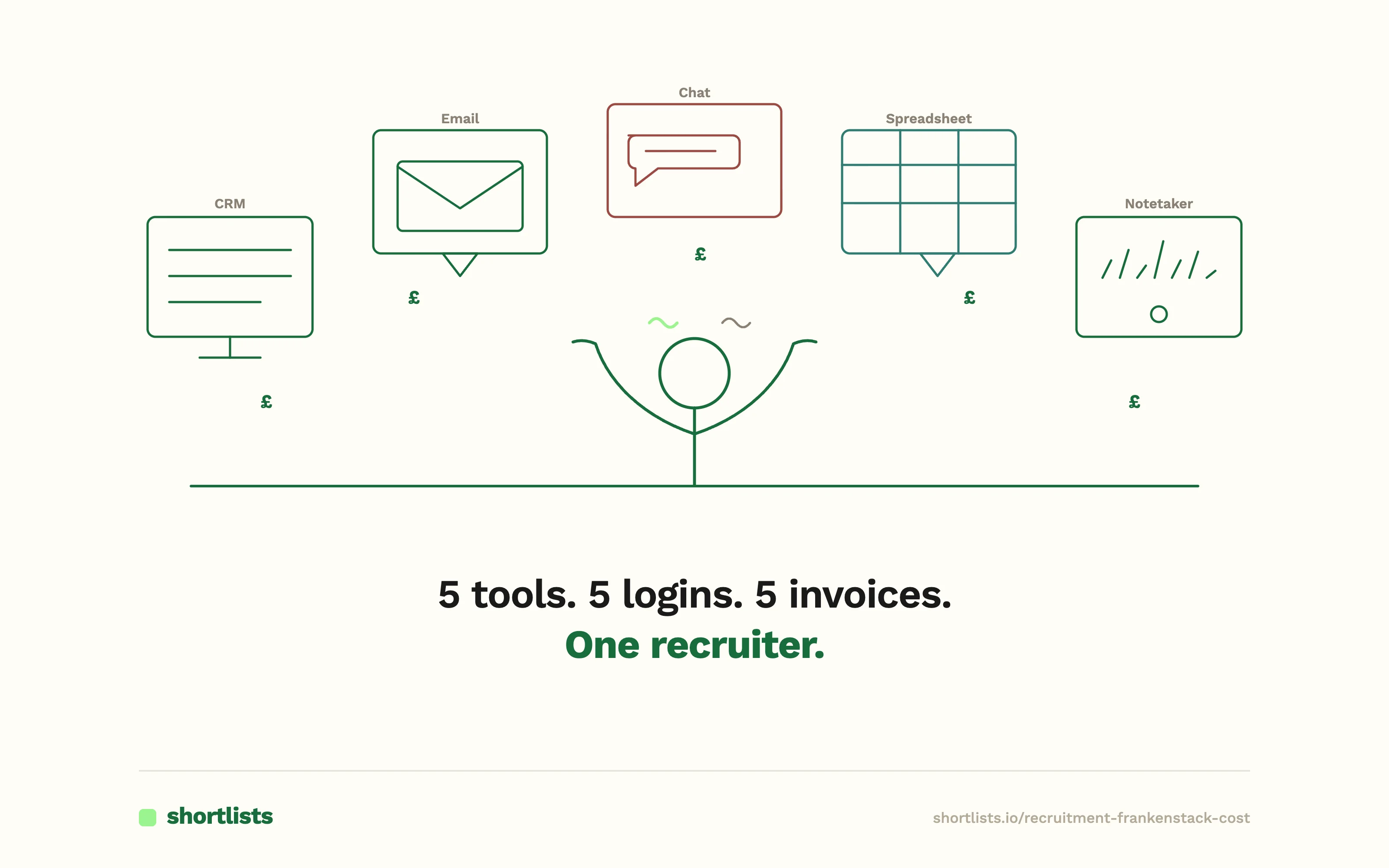
A recruitment Frankenstack is the collection of 4-6 separate tools a recruitment agency stitches together to cover functions a single platform should handle: a CRM, an ATS, a notetaker, a BD tracker, an outreach tool, and an AI tool — each with a separate invoice and login. For a 5-person UK agency, the combined cost typically runs £785-985/month.
Most UK recruitment agencies have a number they think they're paying for software. It's probably the figure on their biggest monthly invoice — the CRM. Maybe it's £400/month for five seats, maybe closer to £600. It feels like a lot, but it's a known cost, a line item someone approved.
The actual number is higher. Often by 40-60%.
The gap lives in what we're calling the Frankenstack: the four, five, six separate tools a small agency stitches together because the CRM doesn't cover everything it should. A notetaker for calls. An outreach tool because the CRM's email sequences are too basic. An AI add-on because AI matching got bolted on as a paid tier. A BD tracker because HubSpot does pipeline management better. Each tool has its own invoice and its own login. No single invoice shows you the full picture. The monthly total only becomes visible when someone sits down and adds it up — and most founders never do, because no one has asked them to.
This piece does that calculation honestly. What the Frankenstack is, how to build the full cost picture for your own stack, how the annual contract structure compounds every pound you're overpaying, and what a no-annual-contract all-in-one alternative actually changes on the numbers.
What is a recruitment Frankenstack?
The term borrows from Frankenstein's monster — a creation assembled from parts that were never designed to work together. In recruitment technology, it describes the layered collection of specialist tools that accumulates as a small agency fills in the gaps around a core CRM.
No agency plans to build a Frankenstack. It happens incrementally. The CRM doesn't produce clean call notes, so someone signs up for Otter on a free tier. The Otter free tier hits its limits, so the team upgrades to tl;dv Pro. The CRM's outreach sequencing is rigid and limited, so someone sets up Apollo for enrichment and email sequences. Someone else finds that tracking business development pipeline in the CRM is clunky, so a HubSpot Starter account appears. AI tools arrive — ChatGPT for job ad drafts, Claude for candidate summaries — used outside the CRM, pasted in manually. Six months later, there are six tools, six logins, and six invoices. The recruiter doing a candidate briefing is switching between three of them.
The 5 tools most 3-10 seat UK agencies are running simultaneously
The composition varies, but the pattern is consistent. In founder conversations across the UK small agency market, the typical Frankenstack for a 3-10 seat shop includes:
A core CRM/ATS. Bullhorn is the most common at the mid-market, followed by Vincere and Loxo. These are the primary database and workflow tool — and the most expensive line item. Most agencies on these platforms are paying for more than they use, because these systems were designed for larger, more complex staffing operations.
A notetaker. Otter, tl;dv, Fireflies — or, if you're on Bullhorn's enterprise tier, Bullhorn Amplify which bundles AI meeting notes. The free tiers of standalone notetakers are usually insufficient for daily use at volume, so most agencies end up on a paid plan.
An outreach or enrichment tool. Apollo, Lemlist, Lusha. The CRM can send emails, but sequence logic, personalisation at scale, and phone number enrichment typically push agencies toward dedicated outreach tools. Apollo's basic tier is widely used; Lusha for contact data enrichment is common alongside it.
A BD tracker. HubSpot Starter is the most frequent answer, sometimes Pipedrive. Some agencies use spreadsheets — which look free but cost recruiter hours. The CRM's BD pipeline view rarely satisfies business development-focused founders who want pipeline reporting that mirrors a proper sales operation.
An AI tool. ChatGPT or Claude, accessed via browser, used to draft job ads, summarise candidate notes, and generate outreach copy. Because these tools sit outside the CRM, the output gets copy-pasted in manually. The AI exists, but it's not integrated.
Why the Frankenstack exists
The agencies building Frankenstacks are not making bad decisions. They're solving real problems with the tools that solve them best. The problem is structural: the dominant recruitment CRM platforms were built for 500-person staffing groups with dedicated ops teams, complex compliance requirements, and enterprise procurement budgets. When a 6-person agency buys one of those platforms, they get a system that handles their core database adequately but leaves gaps on the edges — gaps that specialist tools were built to fill.
Each gap gets patched. Each patch adds a tool. Each tool adds an invoice, a login, a context switch, and a new source of data that doesn't automatically sync with the others. The result isn't a technology problem — it's an economics problem. The aggregate monthly cost of the Frankenstack is often higher than an all-in-one platform would be, and the operational overhead of running five tools instead of one is a direct drag on billable hours.
The true cost of a recruitment Frankenstack (UK 2026 figures)
The numbers below are built for a 5-person agency as a representative example. Where pricing is published on vendor websites, we've used published rates. Where pricing is not publicly listed — Bullhorn being the significant example — figures are drawn from user-reported data collected in agency founder conversations. Bullhorn figures are marked [*] throughout.
Tool-by-tool cost breakdown
| Tool | Per user/month | 5 users/month | Source |
|---|---|---|---|
| Bullhorn (standard tier) | £90-120 [*] | £450-600 | User-reported — pricing not published |
| Bullhorn Amplify AI add-on | £20-30 [*] | £100-150 | User-reported |
| Notetaker (tl;dv Pro) | ~£15 | £75 | Published pricing |
| Outreach tool (Apollo Basic) | ~£20 | £100 | Published pricing |
| BD tracker (HubSpot Starter) | ~£12 | £60 | Published pricing |
| Total | £157-197 | £785-985 |
Year 1 invoice cost (5 users): £9,420-11,820
That's the invoice number. The true number is larger.
What you're not seeing on the invoice
Three costs sit entirely off the invoice, each of them significant.
Annual contract hike. Standard pricing terms across the major recruitment CRM vendors include a renewal uplift clause. The typical language allows the vendor to increase pricing by 8-15% at renewal, with 90 days' written notice. In practice, this means the rate you signed at in Year 1 is not the rate you pay in Year 2. On a £600/month base, a 12% hike is £72/month — £864/year — before you've added any new seats or features.
Migration tax. When an agency eventually decides to leave a CRM, the cost of exit appears. Data migration fees from major platforms typically run £1,500-£5,000 based on agency founder conversations [*user-reported]. Some platforms charge this explicitly; others bundle it in professional services costs for the offboarding process. Either way, it's a switching cost that was never visible when you signed the contract — and that makes leaving feel more expensive than staying, even when staying is the worse financial decision.
Admin time cost. This is the invisible cost most founders never calculate, and it's frequently the largest number on the list. Running five tools instead of one generates friction: switching between systems mid-workflow, manually copying candidate notes from the notetaker into the CRM, reconciling BD pipeline data between the CRM and HubSpot, re-entering outreach data that didn't sync. Conservative estimates from agency conversations put this at 2-3 hours per recruiter per week.
At a conservative £50/hour billed rate for a fee-earning recruiter — and most UK recruiters are billing considerably more than that — two hours of lost time per week per recruiter across five fee-earners is £26,000/year in unbilled capacity. That's not what the Frankenstack costs on the invoice. That's what the Frankenstack costs the business.
The compound effect across 3 years
When you put the invoice cost and the unbilled time cost side by side and project them forward, the picture changes considerably.
Year 1 looks manageable: £10k in invoice costs, plus the £26k time cost if you choose to include it. Most founders only see the £10k figure, which feels like a reasonable software overhead.
Year 2, after a 12% pricing uplift across the board: the invoice cost climbs to roughly £11.2k. The time cost remains consistent. The total picture: ~£37k.
Year 3, with another 15% uplift: invoice cost approaches £13-14k. Across three years, the invoice total alone is £34k+. The total cost including unbilled time is a number that makes most founders uncomfortable when they actually work it out — typically £95-110k for a 5-person agency over three years.
The CRM vendor's Year 3 renewal conversation tends to focus on product improvements and new features. It rarely mentions that the client has spent roughly £100k over three years on a stack they assembled themselves to cover the platform's gaps.
How the annual contract makes it worse
The Frankenstack cost is compounding. The annual contract structure is what makes it sticky.
The 12-month lock-in mechanics
Standard commercial terms across Bullhorn, Vincere, and Loxo include a 12-month minimum commitment. This is disclosed at the point of signing and is not hidden — but its practical implications become clearer only when an agency tries to leave. The 12-month term resets automatically at renewal unless the agency gives notice within a specified window.
That window matters. Most contracts require 90 days' written notice before the renewal date. Miss the window, and you're in for another 12 months at the uplifted rate.
The 90-day cancellation window
The 90-day notice requirement is where most agencies get caught. The logic runs like this: your contract anniversary is September 1st. To avoid automatic renewal, you need to serve notice by June 1st — three full months before the anniversary date, not on it. The decision to leave needs to happen in late May, which means evaluating alternatives, agreeing internally, and putting notice in writing before the end of May.
In practice, the renewal conversation inside most small agencies happens in August. "Our contract renews next month — are we happy?" By that point, the 90-day window has closed. The answer is: you're already renewed.
This isn't malicious. It's contract architecture that favours the vendor. The renewal window is a known feature of SaaS commercial terms, and it's not exclusive to recruitment technology. But in a market where the dominant players have all structured their agreements this way, the cumulative effect is that small agencies find themselves locked into tools they'd prefer to leave, paying rates they'd prefer to negotiate, because the timing never quite worked out.
Why vendors structure contracts this way
Switching costs are the moat. In markets where product differentiation is limited — where CRM A and CRM B both handle placements, job tracking, and candidate databases — the sustainable competitive advantage is exit friction. A customer who can leave is a customer you have to earn every month. A customer who can't leave for the next 11 months is a customer with a predictable lifetime value.
This is not a criticism of how these businesses operate. It's standard SaaS commercial logic. But it means the question you should ask any prospective recruitment software vendor before you sign is not "what can you do?" — it's "what are my terms if I want to leave?"
If the answer involves 90-day notice periods and 12-month minimum commitments, you now know what that means in practice.
What a no-annual-contract CRM actually changes
Month-to-month pricing sounds like a small operational detail. The economics tell a different story.
The economic logic of month-to-month
When there's no annual contract, the relationship between vendor and customer changes structurally. You stay because the product is worth staying for, not because you signed a document that makes leaving expensive. The vendor's incentive to maintain product quality and service responsiveness is different when the customer can leave with 30 days' notice versus 90 days' notice after a 12-month commitment.
This matters more at the small agency end of the market than anywhere else. A 500-person staffing group has a procurement team, a legal team, and an IT function that can run a competitive review. A 5-person agency has one founder juggling placements and making software decisions at 11pm. The annual contract is significantly more burdensome for the smaller buyer.
Without an annual contract, there is also no migration threat. The "switching cost" that vendors use as a retention mechanism — the implicit or explicit reminder that leaving will cost you time and money — disappears when a migration is free and the notice period is short. The decision to stay becomes a question of product value, not switching economics.
What the contract-free all-in number looks like
At $120/user/month all-in — CRM and ATS combined, notetaker included, BD signal layer included, AI matching and AI outreach draft tools included — the maths for a 5-person agency runs as follows:
- Monthly cost: $600
- Year 1: $7,200
- Year 2: $7,200 (rate locked at sign-up — no silent hike)
- Year 3: $7,200
Against the Frankenstack equivalent of £9,420-11,820 in Year 1 invoice costs alone — Shortlists is about £5,700 for the year ($7,200 at $120/user/month) — the saving on invoice cost is £3,720-6,120 in the first year. Across three years, at stable pricing versus a typical 12-15% annual uplift on the Frankenstack, the cumulative gap grows considerably.
The all-in framing matters. The $120/user/month figure includes what the Frankenstack charges separately: AI tools, notetaker functionality, BD pipeline tracking. The headline comparison is not CRM versus CRM — it's the full operational stack versus the full operational stack.
One number. One invoice. No renewal negotiation. No 90-day exit window. The rate you sign up at is the rate you pay.
How to calculate your own Frankenstack cost
The calculation is not complicated, but most agencies have never done it in a single sitting. Here's a five-step worksheet you can run on your own stack in under an hour.
Step 1: List every tool your team uses for recruiting work.
Not just the CRM. Every tool that touches a candidate, a job, a client, or a placement workflow. Include tools that individuals use personally and expense, not just tools that appear on a central team account. Common additions that get missed: personal ChatGPT subscriptions expensed by recruiters, individual Lusha accounts used for enrichment, a Calendly Pro plan used for booking candidate calls.
Step 2: Find the monthly invoice for each tool, or estimate if on a flat team licence.
For annual contracts, divide the annual fee by 12 to get the monthly equivalent. This often makes the true monthly figure feel more real than the annual lump sum that was approved once and filed away.
Step 3: Add any AI add-ons explicitly.
If your CRM has an AI tier you're on — Bullhorn Amplify, for example — list it separately. AI functionality is increasingly sold as a premium add-on rather than a base feature. The cost is real and should be visible.
Step 4: Factor in migration and exit risk.
If you're on an annual contract, what is your exit cost if you wanted to switch platforms today? Check your contract terms for migration fee clauses and data export policies. If you don't know your renewal date, find it now — and count back 90 days. That's your decision window.
Step 5: Add your admin time cost.
Estimate honestly: how many hours per week does each recruiter spend on tool-switching, manual data entry between systems, copy-pasting from the notetaker into the CRM, reconciling pipeline data across platforms? Multiply by the number of fee-earners, multiply by your average billed hourly rate, multiply by 52 weeks. This number typically shocks founders when they see it in writing.
The rule of thumb: if you're running three or more tools and you're on an annual contract, your true cost is almost certainly above £100/user/month — likely significantly above it. If you've never added up all five categories, you probably don't know your real number.
Is switching worth it? (The honest answer)
Switching platforms is a real operational project. It requires time, attention, and a period where the team is learning new workflows. Anyone who tells you otherwise is selling you something. The question isn't whether switching costs anything — it does — but whether the cost of switching is lower than the cost of staying.
When switching makes obvious sense:
You're 6-18 months into an annual contract and just had a renewal conversation where the rate went up. Your Frankenstack has grown to three or more tools and the admin overhead is visibly cutting into billing hours. You've tried to renegotiate with your current vendor and the conversation went nowhere. You're paying AI add-on costs separately when the functionality should be in the base product.
In any of these situations, the financial case for switching typically clears within the first year of the new arrangement. The invoice saving alone often covers the disruption cost.
When switching is more complicated:
You're three months into a 12-month contract with no parallel running option and no migration support from the new vendor. You've built custom API integrations between your CRM and other business systems that took months to develop and would need to be rebuilt. Your team is fully embedded in the current platform's workflow and a learning curve would hit billing velocity during a critical growth period.
None of these conditions make switching impossible. But they change the cost-benefit timeline and require a more careful plan.
What the decision actually comes down to:
Total cost of staying for the next 12 months — invoice cost, time cost, renewal risk — versus total disruption cost of switching — migration time, learning curve, any parallel running period. The calculation changes materially when migration is free and vendor-supported. A CTO-led overnight migration removes the largest single element of switching friction: the data project. When your historical placements, candidate records, and job data arrive in the new system before your team starts on Monday morning, the learning curve is the only remaining variable.
Frequently asked questions
What is a no annual contract recruiting CRM?
A no-annual-contract recruiting CRM is a recruitment platform sold on a rolling monthly basis with no minimum commitment period. You pay month to month and can leave with standard notice — typically 30 days — without penalty or migration fees. In practice, it means the vendor has to earn your continued business every month rather than relying on contract lock-in for retention. Shortlists operates on this model: $120/user/month, no annual contract required.
How much does Bullhorn cost a 5-person UK recruitment agency?
Bullhorn does not publicly list its pricing. Based on user-reported data from agency founder conversations, standard Bullhorn pricing runs approximately £90-120/user/month [] for a small agency, with AI features (Bullhorn Amplify) available as an add-on at approximately £20-30/user/month []. For a 5-person team, that puts the Bullhorn portion of the invoice at approximately £550-750/month before adding any other tools in the stack. These figures should be verified against your specific Bullhorn quote as pricing varies by contract, tier, and negotiation.
What is the recruitment Frankenstack and how do I fix it?
A recruitment Frankenstack is the collection of 4-6 separate tools a recruitment agency assembles to cover functions a single platform should handle — CRM, ATS, notetaker, BD tracker, outreach, AI — each with its own invoice and login. The fix is consolidation: moving to a single platform that handles the full operational workflow at a known all-in monthly cost, without requiring specialist tools to cover the gaps. The migration is typically the barrier that keeps agencies in the Frankenstack longer than makes financial sense; platforms that offer free, supported data migration remove that barrier.
Can I switch from Bullhorn mid-contract?
Yes, with caveats. Bullhorn's standard contract includes a 12-month minimum term with a 90-day cancellation notice requirement. Switching mid-contract means either waiting until you're within the notice window, negotiating an early exit, or running both platforms in parallel during the remaining contract period. The parallel running option — paying for both platforms temporarily while migrating — is sometimes the cleanest path when the cost of staying in Bullhorn for another 9 months exceeds the cost of two months of overlap. The 90-day notice window is the key date to identify first.
What does an all-in-one recruitment platform cost vs. a Frankenstack?
For a 5-person UK recruiting agency, a typical Frankenstack — core CRM, notetaker, outreach tool, BD tracker — runs £785-985/month based on published pricing for individual tools and user-reported data for CRM costs. Shortlists is $120/user/month all-in — about £475/month for the same 5-person team — with CRM, ATS, AI tools, notetaker functionality, and BD signal layer included at that price. The invoice saving is £310-510/month. The time saving — from running one platform instead of five — is additional.
What is Shortlists' pricing?
Shortlists is $120/user/month, all-in. There is no annual contract requirement, no separate AI add-on, and no migration fee. AI matching, AI outreach drafts, and notetaker functionality are included at the base price. The rate you start at is the rate you pay — there is no Year 2 uplift clause. Migration is handled by Lasse, Shortlists' CTO, personally — typically completed overnight so your team starts in the new platform on Monday morning.
What is a frankenstack in recruitment software?
A Frankenstack in recruitment software is a collection of 4-6 separate tools stitched together to cover what a single platform should handle — each with a separate invoice and login. The typical recruitment Frankenstack includes a core CRM/ATS, a standalone notetaker, an outreach or enrichment tool, a BD tracker, and one or more AI tools used outside the CRM. The name reflects the assembled, patched-together nature of the stack: it works, after a fashion, but it was never designed as a whole.
How Shortlists approaches pricing
Shortlists is built for 3-to-10 seat UK recruiting agencies. The pricing reflects that. At $120/user/month, the platform includes everything a small agency's recruitment operation needs to run: a full CRM and ATS, AI matching, AI-assisted outreach drafts, notetaker functionality for calls, and a BD signal layer for pipeline tracking. There is no base tier that excludes AI and no premium tier required to unlock it. One price, one platform, everything included.
There is no annual contract. You pay month to month, and you can leave with standard notice. The rate you sign up at is the rate you pay — there is no renewal clause that allows for year-on-year price increases without your active agreement. This is a deliberate commercial choice: the business is built on the assumption that customers who can leave and don't are a better foundation than customers who can't leave and therefore haven't.
When you switch to Shortlists, migration is free and handled personally by Lasse, Shortlists' CTO. Your historical placements, candidate records, and job data are migrated overnight. Your team starts in the new platform on Monday. There is no migration fee, no professional services charge, and no months-long data project for your ops team to manage. The disruption cost of switching — the element that keeps most agencies in their Frankenstack longer than the numbers justify — is handled for you.
Relevant pages: Pricing · Switch to Shortlists · Compare: Bullhorn vs Shortlists
Next steps
Run the five-step Frankenstack cost worksheet on your own stack. List every tool, find every invoice, and add the time cost. Most founders who do this calculation find the number is higher than they thought — often significantly.
If the number changes the decision calculus, the next useful reads are:
- Bullhorn Alternative UK — what switching actually looks like
- Vincere Alternative for UK Agencies
- Loxo Alternative UK