Boolean-Free Candidate Search: How AI Finds Candidates Without Complex Filters
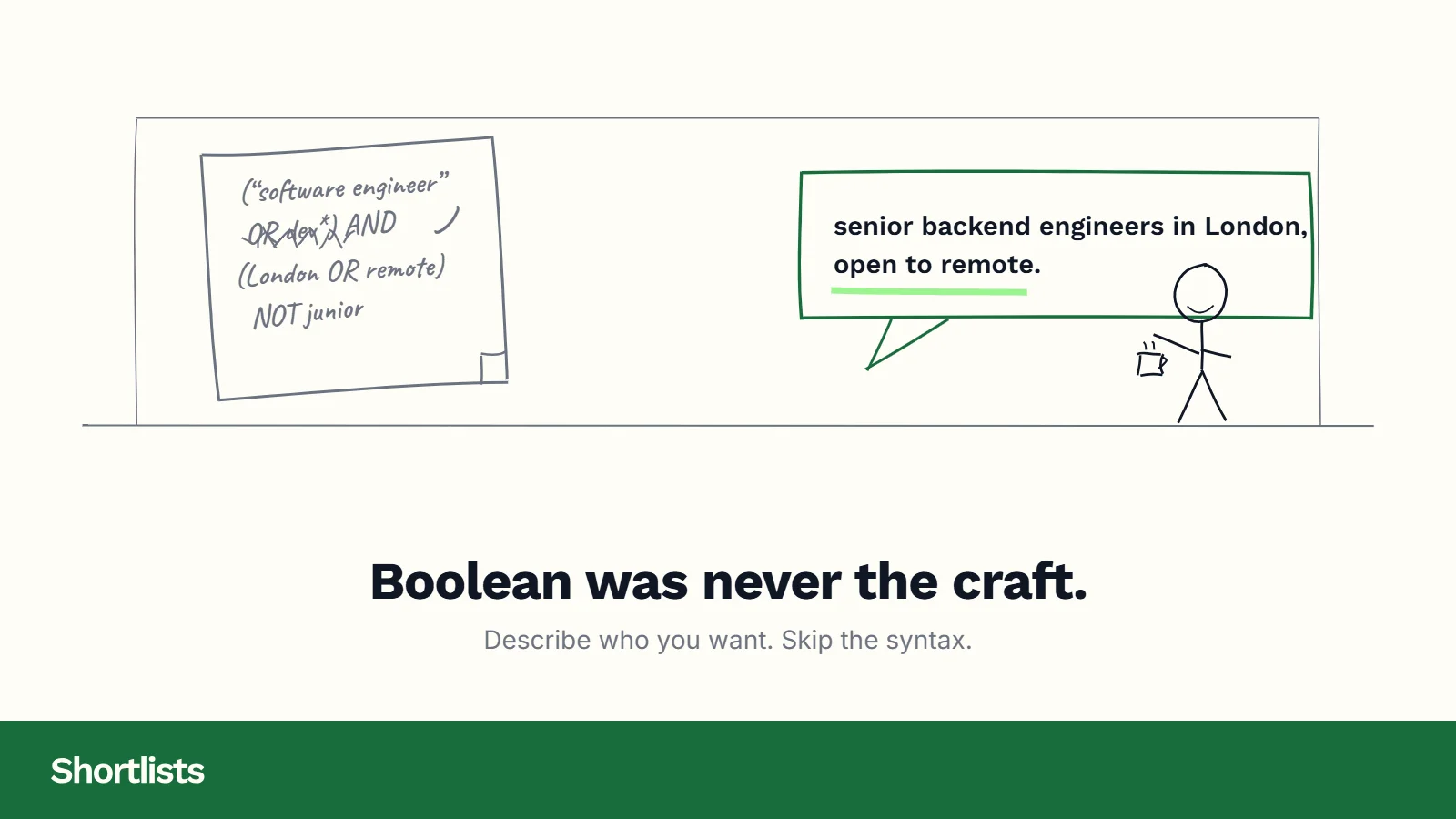
Every Monday, somewhere in a small agency, a recruiter rebuilds the same Boolean string from memory. Something like ("software engineer" OR "backend developer" OR dev*) AND (London OR remote) NOT junior NOT graduate. Forty-odd characters, one bracket out of place, and the right person stays buried in a database you already paid for.
Here is the uncomfortable part. Boolean was never the craft. It was a workaround for databases that could not understand a sentence. You learned the syntax because the tool could not read intent, so you translated your judgment into operators and hoped the parser agreed with you.
Boolean-free candidate search removes that translation step. You describe the person you want in plain English, and the system reads the meaning behind the words, not just the exact strings. This piece covers three things: what Boolean actually costs a small agency, what "boolean-free" really means once you strip the marketing off it, and where AI search genuinely wins versus where you still drive.
One thing up front. This is not an "AI replaces the recruiter" piece. The recruiter still decides who fits. AI takes the query syntax. The craft stays with you.
What Boolean search actually costs a small agency
The cost of Boolean is rarely a single dramatic failure. It is a slow tax, paid in three currencies.
The first is time. A complex search is not typed once and forgotten. It is rebuilt, tweaked, and re-run across a week as a role evolves. Every variation is another few minutes of string-wrangling instead of candidate conversations. For a desk that lives or dies on output, those minutes compound into hours nobody books to a client. [Verify: pull a sourced figure on recruiter time-per-search from REC or Recruiter UK before publish.]
The second is missed candidates. Boolean is unforgiving in a way that punishes good people. A senior backend engineer who lists her title as "Platform Lead" rather than "Senior Software Engineer" will not match a string built around the obvious keywords. She is in your database. She is exactly right. The query simply cannot see her, because keyword matching reads exact strings, not the role she actually does. An OR you forgot to add quietly costs you a placement.
The third is the quietest and the most expensive. Knowledge gets trapped in one person's head. The best Boolean operators in a small agency are usually the founder or the one veteran who has spent a decade building muscle memory. When that person is on holiday, off sick, or simply busy, the database effectively closes for everyone else. Search competence does not transfer, because it lives in syntax only a few people fluently speak.
None of these costs show up on an invoice. They show up as roles that take longer, candidates you never called, and a database that only works when the right human is at the keyboard.
What "boolean-free" really means (and what it doesn't)
"Boolean-free" gets thrown around loosely, so it is worth being precise about what it does and does not mean.
It does not mean dumber search. It does not mean you lose control or precision. And it does not mean the machine decides who you call. It means the burden of translating intent into syntax moves off your shoulders and onto the system.
Searching by intent, not exact string
A keyword filter matches characters. Type "Java" and it looks for the four letters J-A-V-A wherever they appear, which is why it cheerfully returns a JavaScript developer and a candidate whose hobby is a trip to Java. It has no idea what you meant. It only knows what you typed.
Intent-based search works the other way around. You describe the outcome you want, and the system interprets the meaning. Ask for "senior backend engineers in London open to remote" and it understands that "senior" is a seniority band, "backend engineer" is a role family that includes platform and infrastructure titles, "London" is a location with a commutable radius, and "open to remote" is a preference signal. You did not list the synonyms. The system already knew them.
What the search reads: seniority, domain, recency, location, context
The honest way to understand the difference is to look at what each approach can actually read.
A Boolean string reads one thing: exact strings and the logical operators joining them. That is the whole vocabulary.
Semantic search reads several dimensions at once. Seniority, so "lead" and "principal" and "head of" cluster near "senior" without you spelling each one out. Domain, so fintech experience surfaces when you ask for payments knowledge even if the CV never uses your exact phrase. Recency, so a skill someone used five years ago is weighted differently from one they use now. Location, understood as geography and willingness to travel rather than a literal town name. And context, so the difference between someone who managed a team and someone who was managed by one is not lost in a keyword soup.
If you want the engineering detail on how a system represents meaning as vectors and matches on proximity, that belongs in a separate piece. Read how vector search works under the hood for the mechanics. Here we are staying with the experience: what it feels like to search this way, and what it finds.
A worked example: the same search, two ways
Take a live role. A Series A fintech in London needs a senior backend engineer, ideally with payments experience, open to a hybrid arrangement, and not too junior.
The Boolean way looks like this:
("senior software engineer" OR "backend engineer" OR "backend developer" OR "platform engineer") AND (payments OR fintech OR "financial services") AND (London OR "Greater London" OR remote OR hybrid) NOT (junior OR graduate OR intern OR placement)
That string took real effort to build. It is fragile. Forget the OR "platform engineer" clause and you miss a tranche of qualified people who happen to carry that title. Add one bracket in the wrong place and the whole logic collapses. And it still only matches the exact words you remembered to include.
The plain-English way looks like this:
senior backend engineers in London with payments or fintech experience, open to hybrid, not junior
Same database. Same intent. The second query reads the seniority band, expands the role family to adjacent titles you did not type, understands payments as a domain rather than a literal keyword, treats London as a commutable area, and ranks the results by how well each candidate matches the whole description rather than how many keywords they happen to contain.
The point is not that plain English is easier to type, though it is. The point is that it surfaces the Platform Lead with payments experience who the Boolean string would have skipped, because the meaning was there even when the keyword was not.
Where AI search wins and where you still drive
Anti-hype is the only honest register here, so here is the clean division of labour.
AI search wins at three things. It surfaces, pulling the long list of plausible matches from a database faster than any manual query. It expands, reading synonyms, adjacent titles, and related domains you would otherwise have to enumerate by hand. And it ranks, ordering candidates by fit against your full description rather than by keyword count.
You still drive everything that follows. AI cannot tell you whether a candidate is genuinely motivated to move right now. It cannot read the politics of why someone left, or sense that a CV that looks perfect belongs to someone who would hate this particular team. It does not know your client's real, unwritten brief, the one that lives in a phone call and never makes it into the job spec. And it cannot build the relationship that turns a name on a shortlist into a placement.
That is the line. AI surfaces and ranks. The recruiter judges fit, motivation, and timing. The search stops being a syntax exam and goes back to being what it should always have been: a fast way to find the right people you already know are in there, so your hours go to the conversations only you can have.
Frequently asked questions
What is boolean-free candidate search?
Boolean-free candidate search lets you find candidates by describing who you want in plain English, instead of building a query from operators like AND, OR, and NOT. The system reads the intent behind your words, including seniority, role family, domain, and location, and ranks people by how well they match the whole description rather than by exact keyword.
Is AI candidate search better than Boolean search?
For most everyday searches, yes, because it reads meaning rather than exact strings and surfaces qualified people whose CVs use different words than you expected. Boolean still has a place when you need surgical, rule-based precision. The practical answer for a small agency is that plain-English search handles the bulk faster, and you keep Boolean for the rare edge case.
Does AI candidate screening miss good candidates?
Every search method misses someone, but the failure modes differ. Boolean misses people who use unexpected titles or synonyms. Semantic search reduces that specific gap by reading intent and adjacent terms. It is not flawless, which is why it surfaces and ranks rather than decides. The recruiter still reviews the shortlist and makes the call on fit.
Can AI search my existing candidate database?
Yes. Boolean-free search runs against the candidates you already hold in your CRM, which is the point: it helps you rediscover qualified people already in your database who keyword filters skip. There is no need to source from scratch. You describe who you want, and the system reads your own records for the meaning, not just the matching strings.
Do I still need to know Boolean if my CRM has AI search?
You do not need it for day-to-day searching. Knowing Boolean is still useful for the occasional precise, rule-based query, and it helps you reason about what a search is doing. But the muscle memory of rebuilding long strings every Monday stops being a job requirement. The skill that matters is describing who you want clearly, which you already have.
How Shortlists handles this
Shortlists is a recruiting CRM built for small UK agencies, and its AI co-pilot for recruiters reads your plain-English description against your own candidate records, surfacing and ranking the people who match the intent rather than only the exact strings. The search is included at the base price of $120/user/month, not sold as an add-on. You describe who you want. Shortlists reads your database. You decide who fits.
Next steps
If you are weighing up what a CRM should actually do for a small desk, read the features small agencies actually use and how to keep one place for clients, candidates and jobs. For the engineering detail behind semantic matching, see how vector search works under the hood. Or explore the full recruiting CRM built for small UK agencies and the AI co-pilot for recruiters.
AI takes the admin. The craft stays with you.