Growing a Small UK Recruitment Agency in 2026: The Founder's Guide

The growth model that works for 3-10 seat UK recruiting agencies is depth, not headcount. Sustainable growth means building a proactive BD system (finding roles before they're posted), deepening niche specialisation, and using the founder's voice as a compounding channel — rather than hiring billers before the pipeline system is proven.
There are roughly 26,000 recruitment agencies in the UK. Most are under 10 people. Almost none of the content written about growing a recruitment agency is written for them.
The blog posts, the books, the LinkedIn threads — they're written for the 200-person operations that already know how to grow, or for the ambitious founder who's convinced that 200 people is where they're headed. The assumptions baked in are enterprise assumptions: structured L&D, tiered management, desk specialisation, marketing teams, ATS implementations with six-figure price tags.
If you're running a 4-person niche agency in Manchester or Bristol or Leeds, none of that is your reality. And the growth playbook built for enterprises doesn't just fail to help you — it actively damages you when you try to run it. The agencies that attempt it end up with bloated headcount, a niche they can no longer credibly claim, and margins that don't justify the chaos of managing a team twice the size it should be.
What actually works for 3-10 seat UK niche agencies is different. And we know this not because of theory, but because of 220 conversations with UK agency founders — owners of exactly these kinds of businesses, across sectors, at every stage from start-up to established. This is what they said. This is what the data shows. This is what actually works.
The growth trap: why scaling headcount kills the niche
The default growth model — and why it fails for small niche agencies
The enterprise growth model is simple: hire more billers, open more desks, add more capacity, generate more revenue. It works at scale because a large firm's brand and candidate database carry weight on their own. A senior hire at PageGroup isn't expected to build a desk from scratch — the infrastructure is already there.
For a 5-person niche agency, none of that infrastructure exists. Your desk capacity isn't the constraint. Your relationship depth is. Your niche authority is. Your ability to get a call returned from a hiring manager who trusts you specifically — not your brand, you — is the asset.
The moment you hire a recruiter who doesn't have that depth of relationship in your niche, you've diluted it. They need to build from scratch. While they're building, they're a cost. They're also, almost inevitably, tempted to go slightly off-niche to generate quick fees — and slowly, the niche dissolves. This is one of the most consistent patterns from the 220 founder conversations: agencies that hired ahead of their BD system ended up broader, blander, and less profitable than they were before.
What growth actually looks like for a 3-10 seat agency
Revenue per recruiter is the right metric. Not headcount, not desk count, not placement volume.
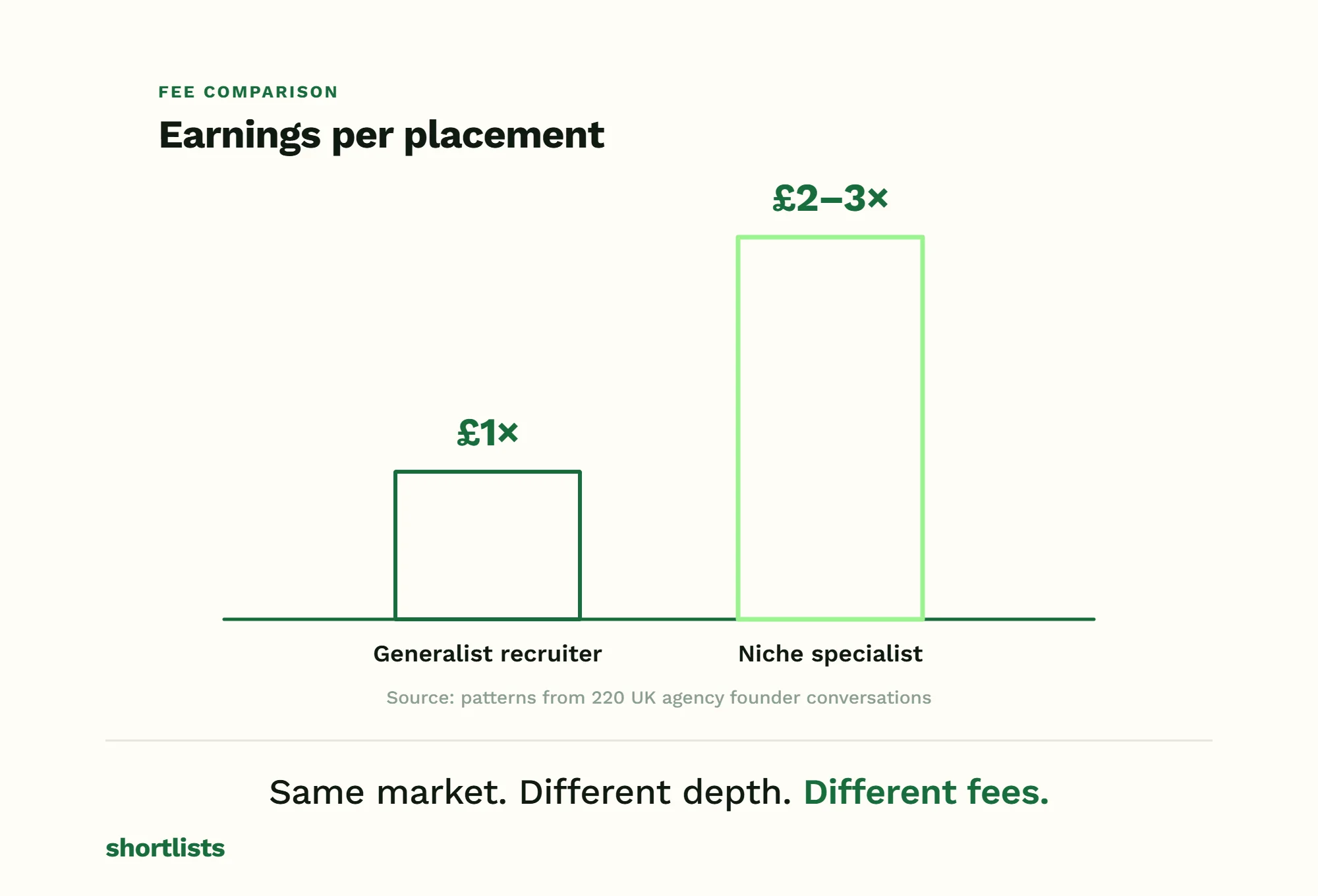
From those 220 conversations, niche specialist agencies consistently earn 2-3x more per recruiter than generalist agencies at the same total headcount. The mechanisms behind this premium are well understood by agency founders who've built it: faster time-to-shortlist, higher placement fees, retained mandates rather than contingent rolls of the dice, and a referral network that brings warm roles before they ever hit a job board.
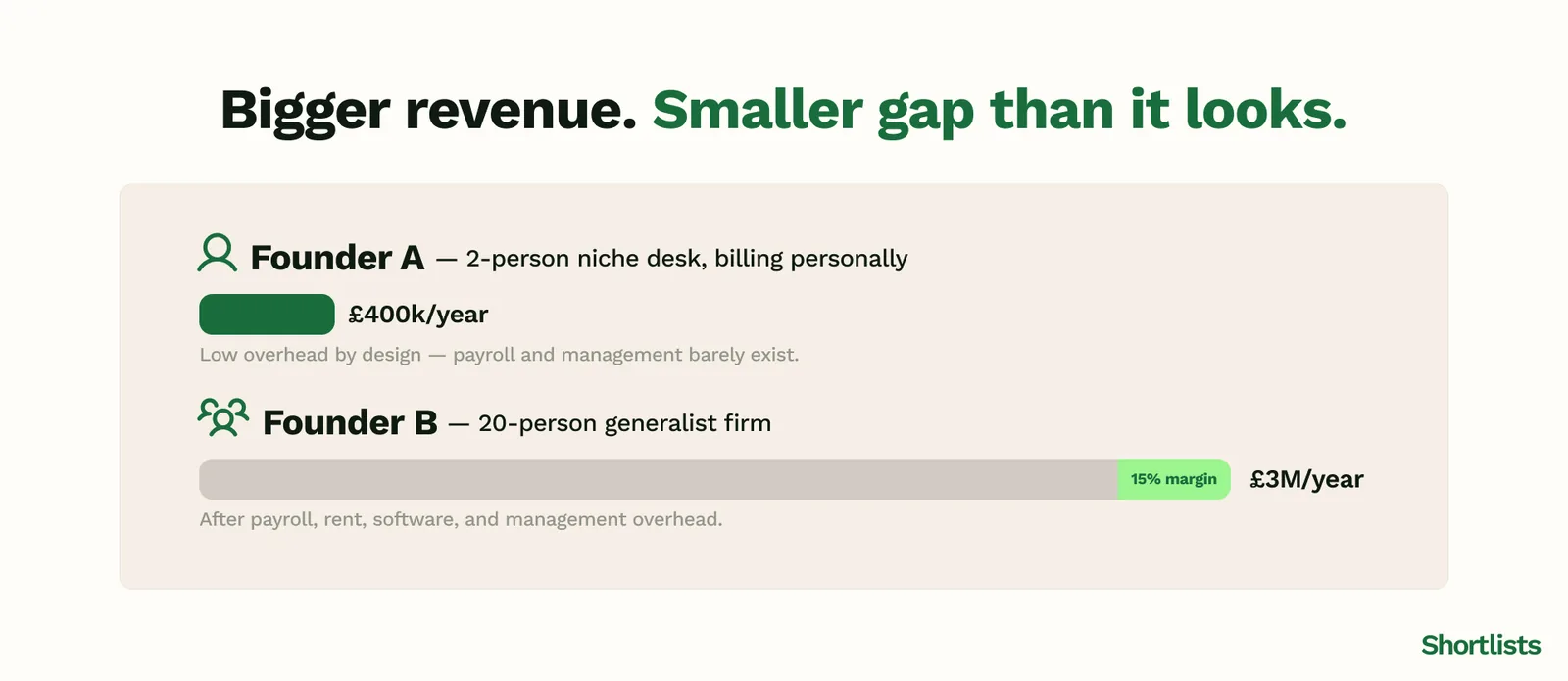
Consider two founders at the same stage of their career. One is billing £400k/year themselves and running a lean 2-person operation. The other is managing a 20-person firm with £3M revenue — and 15% margins. Take away payroll, rent, software, management overhead, and the gap in actual founder earnings is far smaller than the headline revenue suggests. The 20-person operation has more prestige. The 2-person operation has more freedom, more margin, and — critically — more control over the niche it owns.
Neither choice is inherently right. But the 3-10 seat founder who assumes bigger is always better is making an assumption that deserves to be questioned.
The 4 stages of a small agency's growth curve
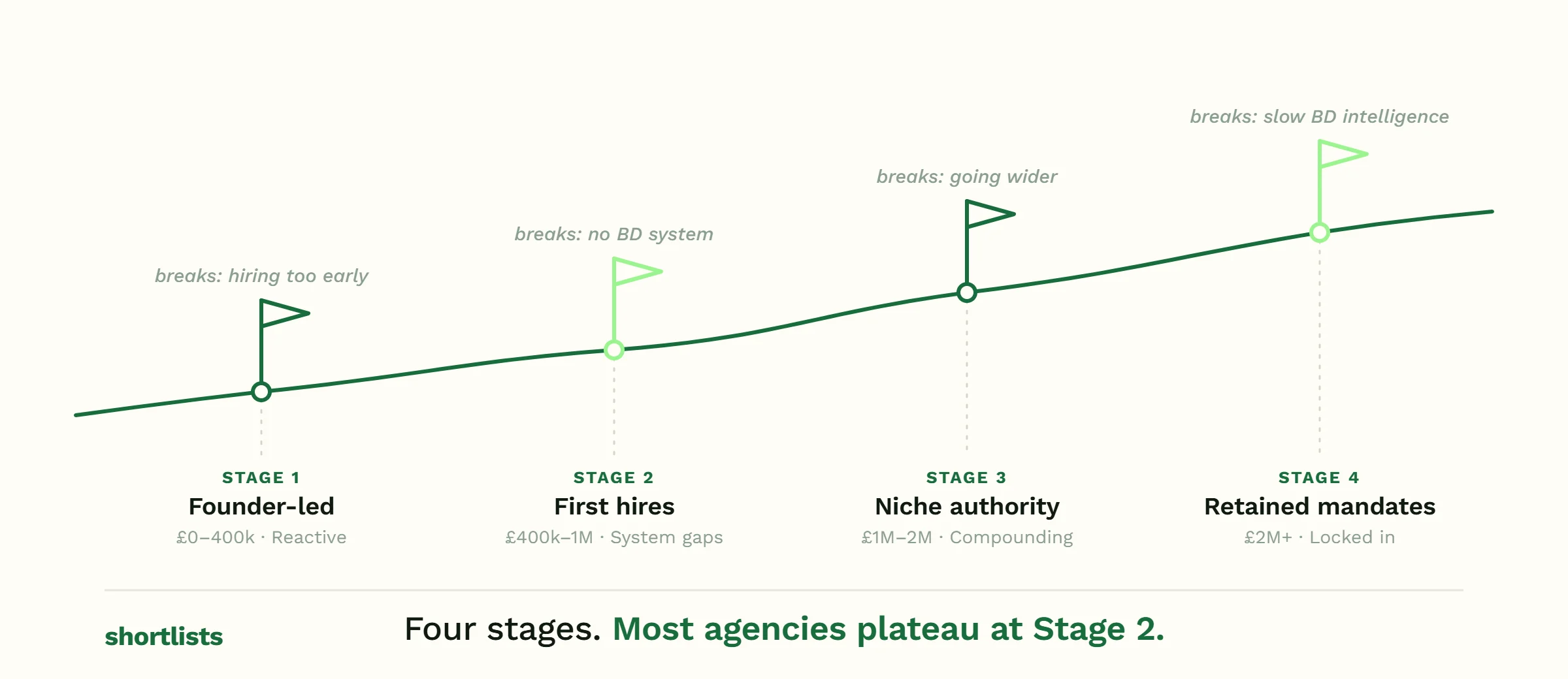
Stage 1 — Founder-led, word-of-mouth, reactive (£0–400k)
At this stage, the business is the founder. Everything that works is personal: your relationships, your reputation, the trust you built at your old agency. New business comes in because someone you placed five years ago has moved to a new role and remembered you. The pipeline is healthy but fragile — it exists entirely in your head and your inbox.
What works here: founder relationship capital, personal reputation, and the warm network. These are real assets.
What breaks it: hiring a junior recruiter before you've built a BD system. The founder's relationships don't transfer. The junior has no pipeline and no relationships, so they go fishing on job boards. You've added a cost without adding a proven revenue-generating mechanism.
The other trap at this stage: going generalist to fill capacity. There are periods when the niche is quiet and there's temptation to take a role in an adjacent sector because "it's not that different." It is that different. Every generalist role you fill is time not spent deepening the relationships that make the niche defensible.
Stage 2 — First hires, first systems, first process gaps (£400k–1M)
This is where most founders make the first expensive hiring mistake. The business is growing, the pipeline feels manageable, and the logical next step seems to be getting someone else to help with the work.
But if the work they're helping with is reactive — responding to inbound roles, sourcing candidates for your live mandates — then you've built a capacity solution for a demand problem. The moment your inbound slows, you're carrying headcount with nothing for them to do.
The fix is counterintuitive: BD system first, headcount second. Before you hire anyone, you need a consistent, repeatable mechanism for generating new business that doesn't depend entirely on your personal network. That mechanism is what the rest of this piece is about. Only once it's generating more opportunity than you can personally handle does it make sense to add people.
At this stage, the founder is still doing all the BD — and suddenly also managing a team. That split attention is the most common reason agencies plateau between £400k and £1M.
Stage 3 — Niche authority building (£1M–2M)
The agencies that break through to this stage have usually solved the BD system problem. They have a consistent mechanism for finding new business, they're known in their niche, and something interesting starts to happen: the niche starts to work for them.
Referrals arrive without asking. Candidates refer hiring managers. Hiring managers refer candidates. Both refer other hiring managers. You start getting calls from people who found you through someone you placed three years ago, someone you never consciously networked with. The niche has become a community, and the community is routing its best recruitment problems to you.
This is the compound effect of niche depth. It takes time — typically two to four years of consistent focus — but once it's running, it's nearly impossible for a generalist firm to replicate at any headcount.
At this stage, thought leadership becomes valuable. Not as a marketing exercise, but as a mechanism for deepening the community relationship. The founders who do it well aren't writing blog posts to generate clicks. They're sharing market intelligence that hiring managers in their niche genuinely find useful. That distinction matters.
Stage 4 — Retained relationships and locked mandates (£2M+)
The shift from contingent to retained is the most significant commercial step a small agency can make — and the most misunderstood. Most founders assume you have to earn retained work through years of placements and relationship-building. Many have. But the deeper requirement is something else: you have to be the most credible voice in the room about what that hire actually looks like.
When you're placing one function in one sector, and you've been doing it for four years, you know what the right answer is before the client does. You can tell them what salary range will attract the candidate profile they actually need, not the profile they think they want. You can tell them what the talent market looks like right now in their specific geography. You can name four candidates who could do the job and explain why each one would succeed or fail in their culture.
That's retained-quality credibility. No 50-person generalist firm can match it in your niche. And that's precisely why a 3-10 seat specialist agency can win retained mandates against much larger competitors — and why the tool stack matters more at this stage. Retained mandates require speed, and speed requires intelligence. More on that below.
The BD system gap — why most small agencies plateau
The Monday morning test
Here's a question that separates the agencies that plateau from the ones that don't: "What does your Monday morning look like?"
For reactive recruiters — which is most of them, and there's no shame in it, it's how most of us were trained — Monday morning looks like this: open LinkedIn Jobs, refresh Reed, check the inbox for new inbound roles. Maybe spend some time on a few candidate searches. Wait for the phone to ring.
By the time a reactive recruiter sees a role that's been posted on a job board, twelve other agencies have already pitched. Eleven of them will fail, but they'll fail alongside you, and the client's experience is that their inbox is full of generic capability statements from people who all say the same things about candidate databases and speed to shortlist.
For a proactive recruiter, Monday morning looks different. Twenty-five minutes reading signals. Eight to fifteen warm BD opportunities identified for the week — not cold calls, not speculative emails, but genuinely warm contacts where something has happened that gives the recruiter a credible, timely reason to pick up the phone.
The conversion rate difference between those two Mondays is not marginal. It's structural.
The 4 signals that arrive before a role is posted
There are four signals that reliably precede a hiring decision by 60-90 days:
Funding round. A company closes a Series A or Series B. Within 60-90 days, hiring accelerates across almost every function. The founders are spending the money they raised — and they're spending it on people. If your niche intersects with that company's hiring profile, you want to be in front of the relevant hiring manager before their job specs are drafted, not after they're posted.
VP hire. A new senior leader joins. Within the first 90 days, new VPs almost always restructure. That means new roles, backfill roles, and often a preference for doing at least some of that hiring with an external partner rather than the internal TA team who reported to the previous VP. The recruiter who calls the day after a VP hire announcement is the one most likely to be given the first mandate.
Senior leaver. A VP or Director exits a company in your niche. That's an immediate backfill opportunity, plus the ripple hires that follow when a leadership gap creates structural instability below it. These roles are often time-pressured and require a recruiter the company trusts immediately — which is a relationship advantage for the niche specialist.
Adjacent-role volume. Three or more adjacent roles posted by the same company in a short period is a clear signal of a growth phase. It means budget has been released, hiring managers have been given headcount, and the company is in active recruitment mode. The recruiter who spots this pattern and makes contact before the fourth or fifth role is posted is already ahead.
None of these signals require proprietary intelligence. They're all publicly available. The difference is whether you have a system that surfaces them — or whether you're checking job boards on Monday morning. (BD Radar is built to surface all four automatically.)
Why most CRMs don't solve this problem
The honest reason most recruitment CRMs don't solve the BD problem is that they weren't designed for it. ATS-first products are built for the right side of the funnel: candidates in, placements out. The workflows, the databases, the automation — all of it is optimised for managing active requirements and moving candidates through stages.
The left side of the funnel — the BD pipeline, the signal monitoring, the proactive outreach — is typically managed on a spreadsheet, a separate tool, or a combination of both. When those tools don't talk to each other, recruiters spend time copying information between systems. When they stop doing that, information gets lost. When information gets lost, follow-ups don't happen. When follow-ups don't happen, opportunities die.
The Frankenstack — the constellation of loosely connected tools that most 3-10 seat agencies end up running — is not a technology failure. It's a symptom of how recruitment software has historically been built: for the candidate side of the business, not the client side.
Niche strategy — the single most important growth decision
Why generalists convert 3x worse than niche specialists
From 220 founder conversations, this is one of the most consistent findings: niche agencies close faster, charge higher fees, and win retained mandates at a meaningfully higher rate than generalist agencies at the same headcount.
The mechanism is simple. When you're the acknowledged expert in a specific function within a specific sector, the hiring manager isn't comparing you to seven other agencies. They're asking whether they need you or can manage without you. That's a fundamentally different conversation — and it closes faster.
The 2-3x earnings premium for niche specialists is not theoretical. It shows up in fee rates (niche specialists can credibly charge 20-25% where generalists are under pressure to compete on 15%), in placement volume per recruiter (deeper relationships mean more repeat business), and in retained work (which eliminates the contingent risk entirely).
How to pick a niche if you haven't yet
If you're still operating as a generalist and wondering whether to niche down, the answer is almost certainly yes. The question is how.
Start where you've already won. Look at your best placements, your best client relationships, your highest fees. There's almost always a pattern — a sector, a function, or a combination of both where your relationships are deepest and your conversion rate is highest.
Then ask whether that pattern gives you a signal intelligence edge. Some sectors are more signal-rich than others. Technology, fintech, and professional services, for example, generate a high volume of funding news, senior appointments, and company filings that give proactive recruiters an intelligence advantage. If your niche is in a signal-rich sector, the BD system compounds faster.
The practical test: can you name 20 hiring managers in this vertical who would take your call this week? Not 20 people who might eventually take your call. Twenty who would take it today. If yes, that's your niche. If not, you're not there yet — but you know what you're building toward.
What happens when you niche down
The short-term experience of niching down is uncomfortable. The pipeline looks thinner because there are fewer roles in scope. There are weeks where nothing in your niche is moving and you're watching opportunities in adjacent areas go past. The temptation to widen is real.
The medium-term experience is different. Relationships deepen faster because you're a known quantity rather than another generalist recruiter. Cycles shorten because you already know the candidate pool and the hiring manager doesn't need to brief you from scratch. Fees hold up because you're not competing on price.
The long-term experience is what the 220 conversations describe as the referring network: the self-sustaining ecosystem of relationships in which you become the agency of record by default. You're not winning new clients at that point. They're being sent to you.
Hiring for growth — the decision most founders get wrong
When to hire — and when not to
The right time to hire your first recruiter is when your BD system is generating more pipeline than you can personally work. Not when you think it might, soon. Not when you've had a good quarter and feel confident. When the pipeline is consistently overflowing and you are demonstrably the bottleneck.
If you hire before that point, you're not adding capacity — you're adding cost. The new hire will need a pipeline to work. If yours isn't generating overflow, they'll go fishing on job boards. The niche starts to dilute. The culture starts to shift from specialist depth to volume.
Who to hire first
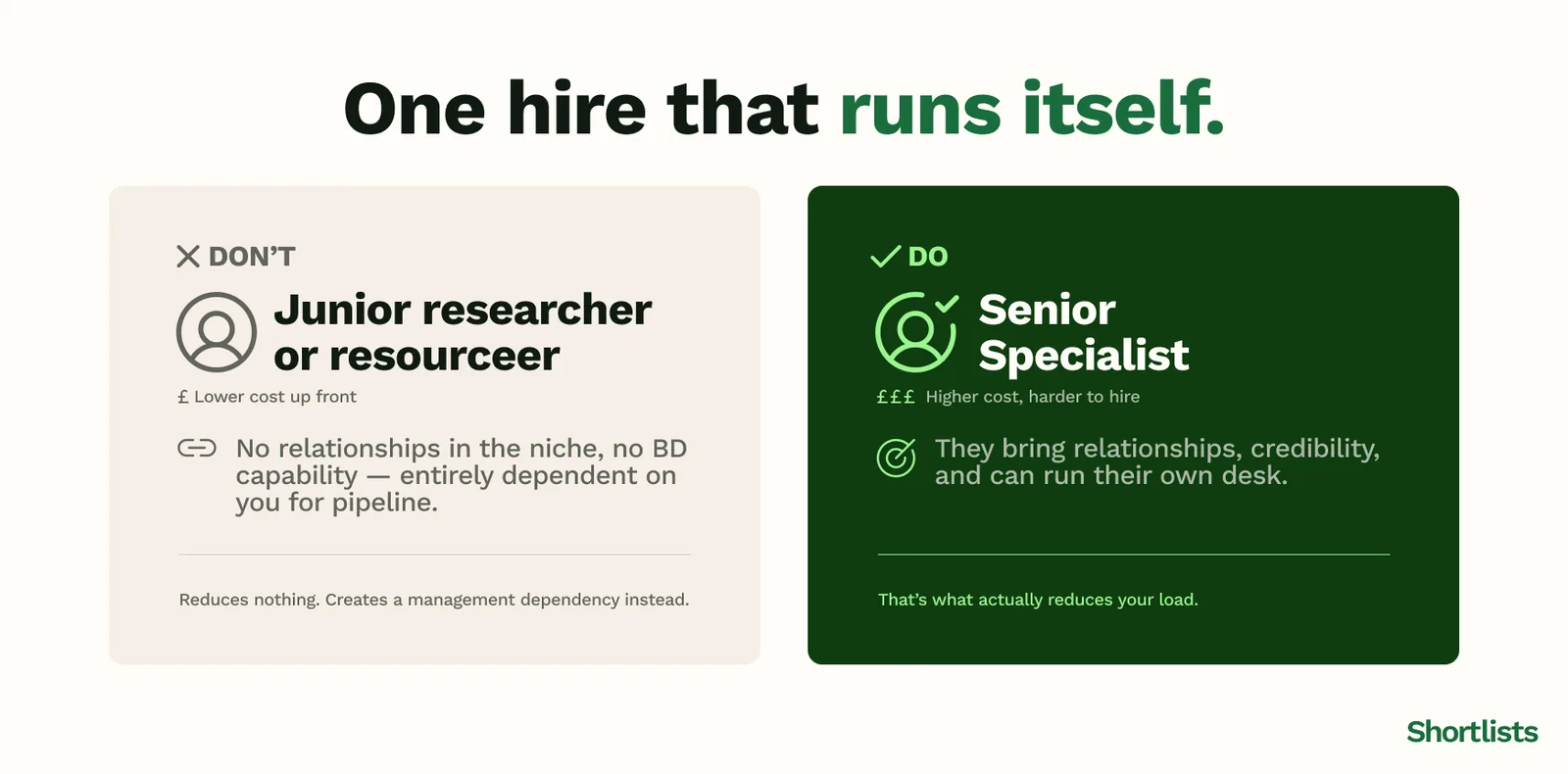
Most founders get this backwards: they hire a junior researcher or resourcer to take load off themselves, when the more powerful first hire is a senior billing recruiter who can both work the pipeline and build it.
The argument for a junior hire is usually cost. The argument against it is that a junior recruiter in a niche agency has no relationships in the niche, no reputation in the niche, and no BD capability. They're entirely dependent on the founder for pipeline. That doesn't reduce the founder's workload — it creates a management dependency instead.
A senior specialist hire is more expensive, more demanding to recruit, and more challenging to manage — because they know what good looks like and won't accept less. But they bring relationships, they bring credibility in the niche, and they can run their own desk. That's what actually reduces the founder's load.
The culture trap
The agencies that hire for headcount rather than fit end up managing a culture problem within 18 months. This is not anecdotal — it's one of the most recurring themes from the founder conversations.
A 5-person team has no room for someone who doesn't share the values of the practice. There's no middle management buffer, no performance management infrastructure, no HR team. The culture is whatever the people in the room embody. One wrong hire can fundamentally change that culture, and in a small agency, a culture problem is also a commercial problem — because the relationships that clients trust are personal, and they notice when the agency changes.
"Runs their own desk" is the phrase most founders use when describing what they want from a hire. What it actually requires in a 5-person team is both autonomy and alignment — someone who doesn't need to be managed, but who genuinely buys into what you're building. That's a harder search than hiring for experience alone.
Proactive recruiting — the founder's growth engine
The transition from billing founder to CEO founder
There's a moment in most growing agency founders' careers when the decision has to be made: keep billing, or start building?
Most founders wait too long to make it. The signals are there — you're the bottleneck on every deal, you can't take a week off without the pipeline stalling, every client relationship is personal to you and therefore non-transferable. But billing feels productive. It generates immediate revenue. Stopping feels like risk.
The transition from billing founder to CEO founder isn't about stopping overnight. It's about consciously investing in the systems, relationships, and team culture that outlast any individual billing quarter. The founder who never makes that transition owns a job. The founder who makes it owns a business.
Knowing when you've crossed the threshold: when the business would generate more long-term value from the founder doing BD, content, and team leadership than from the founder filling roles. For most founders, that crossing happens somewhere between £500k and £1M revenue. The exact point varies by niche, by team, by personal preference. But the question is worth asking.
Founder-led content as a growth lever
The niche specialist founder has something the 50-person operation categorically doesn't: a recognisable, trusted, individual voice in a specific community.
That voice is a growth lever. Not because it generates SEO traffic (though it does, eventually). Not because it builds a personal brand in the abstract (though it does that too). Because it makes the founder the person that hiring managers in the niche call for market intelligence — before they have a role to fill.
What "thought leadership" actually means for a 5-person agency is being genuinely useful to the people you want to work with. Sharing what you're seeing in the talent market. Telling hiring managers in your niche what salary ranges are clearing and which aren't. Commenting on a structural change in the sector that has hiring implications. That's market intelligence, and it's valuable.
LinkedIn is the compounding channel for this. It takes six months of consistent posting before results become visible. Most founders start, see nothing happen in month two, and stop. The founders who keep going find that by month eight or nine, they're getting inbound calls from hiring managers who say they've been following their posts for a while and have something they'd like to talk about.
That's the compounding effect in action. It's slow to start. It doesn't stop.
Tools, systems, and the stack that doesn't slow you down
The minimum viable stack at each growth stage
At Stages 1 and 2 — sub-£1M, fewer than five people — the stack should be minimal. A CRM that works well for one or two recruiters, a notetaker or call recorder, and a simple BD tracker that keeps warm opportunities visible. The risk at this stage is over-investing in software before the processes that software needs to support are actually established.
At Stages 3 and 4 — above £1M, team of five to ten — the requirements change. The BD intelligence layer matters more because proactive BD at this scale needs to be systematic, not individual. AI matching starts to generate real time savings. Client portal functionality matters because retained clients expect it. Team pipeline visibility becomes essential because the founder can no longer hold all the context in their head.
The stack at this stage should be doing the heavy lifting that used to be manual: surfacing signals, flagging warm BD opportunities, tracking relationship health, keeping the team aligned without the founder having to run a daily standup to compensate for what the software isn't doing.
When the Frankenstack becomes a growth ceiling
The average recruiter in a Frankenstack environment — where the ATS, the CRM, the BD tracker, the notetaker, and the email tool are all separate and loosely connected — spends somewhere in the region of 10 hours per week on admin that doesn't generate fees. Copying data between systems. Reconciling records. Chasing down context that should be in the CRM but isn't.
At five people, that's 50 hours per week not billing. Over a year, that's a significant drag on revenue. It's also a drag on morale — recruiters don't leave big agencies to build something better and then spend their mornings updating spreadsheets.
A consolidated stack gives back time, context, and signal. The time is obvious. The context — having a complete, accurate picture of every client relationship in one place — is what makes high-quality BD conversations possible. The signal is what turns a Monday morning from reactive to proactive.
Frequently asked questions
What is the best way to grow a small UK recruitment agency?
Build depth, not headcount. The agencies that grow most sustainably in the 3-10 seat range do three things: they build a proactive BD system that finds roles before they're posted, they deepen their niche rather than widening it, and they use the founder's voice as a compounding channel in the community they serve. Headcount follows pipeline — not the other way around.
How do niche recruitment agencies grow faster than generalists?
Niche specialists close faster, charge higher fees, and win retained mandates at a meaningfully higher rate than generalists. From 220 UK founder conversations, niche agencies consistently achieve a 2-3x earnings premium per recruiter over generalist agencies at the same headcount. The mechanism: deeper relationships mean less competition at the point of mandate, higher trust means higher fee rates, and retained mandates eliminate contingent risk entirely.
When should a small recruitment agency hire their first employee?
When your BD system is generating more pipeline than you can personally work — consistently, not just in a good month. Not before. The most expensive hiring mistake in 3-10 seat agencies is adding a recruiter before the BD system is proven, because the new hire has no pipeline of their own and ends up fishing on job boards, which dilutes the niche and adds cost without adding proven revenue.
What tools does a 3-10 person recruitment agency need to grow?
At minimum: a CRM, an ATS, a notetaker, and a BD signal layer — preferably consolidated in a single platform rather than four separate tools. The Frankenstack of disconnected tools costs the average recruiter around 10 hours per week in admin overhead that doesn't generate fees. At five people, that's 50 hours per week. A consolidated stack gives that time back.
How do recruitment agencies find new clients without cold calling?
Signal-led BD. Monitor four signals each week: funding rounds (upcoming hiring surge in 60-90 days), VP hires (restructure and new mandates within 90 days), senior leavers (backfill and ripple opportunities), and adjacent-role volume (company in active growth mode). Each signal gives you a credible, timely reason to pick up the phone — which converts at a fundamentally different rate than a cold call.
What is the 2-3x earnings premium for niche specialist agencies?
Based on synthesis across 220 UK agency founder conversations, niche specialist agencies consistently earn 2-3x more per recruiter than generalist agencies at equivalent headcount. This premium shows up in fee rates (niche specialists hold 20-25% where generalists compete on 15%), in placement volume per recruiter (deeper relationships generate more repeat business), and in retained mandates, which eliminate contingent risk and deliver predictable revenue.
What is the best BD strategy for a 5-person UK recruitment agency?
Signal-led BD. The most effective Monday morning routine for a 5-person agency is 25 minutes reading four signals — funding rounds, VP hires, senior leavers, adjacent-role volume — which generates 8-15 genuinely warm BD opportunities for the week. Warm contacts (where something relevant has happened in the last 48-72 hours) convert at a fundamentally different rate than responding to live job postings. This is the single most consistent differentiator between agencies that plateau and agencies that break through.
How Shortlists fits into a growth system
Shortlists is a UK-built recruiting CRM/ATS designed specifically for 3-10 seat UK agencies — the exact segment this piece is written about. The platform is built around the insight that the biggest gap in most small agency stacks is the BD intelligence layer: the mechanism that surfaces signals before roles are posted and keeps the proactive BD system running without manual overhead.
BD Radar is Shortlists' built-in signal monitoring layer. It surfaces funding rounds, VP hires, senior leavers, and adjacent-role volume — the four signals described in this piece — automatically, inside the same platform where recruiters manage their pipeline and candidates. No Frankenstack. No manual signal-monitoring. A revenue dashboard keeps what the pipeline is worth visible at all times. The Monday morning 25 minutes is built into the workflow.
The platform is AI-native, with matching and admin automation included in the base price. At £79/user/month all-in — no annual contract required, free migration — it's built to be accessible to the 3-10 seat agency that can't justify enterprise software pricing. More at BD Radar features and Shortlists pricing.
Next steps
- Download the Q2 BD Playbook — coming soon
- Coming soon: The 4 Signals Before a Job is Posted
- Read: The Recruitment Frankenstack cost guide
- Read: BD Radar: How UK Recruiters Find Hiring Signals Before Jobs Are Posted
- Read: What CRM features does a 3-10 person UK recruitment agency actually need?
- Compare: Shortlists vs Bullhorn
- Compare: Shortlists vs Vincere
- Compare: Shortlists vs Loxo